Monday, October 22, 2012

Monday Pointers 2012-10-22

D4: Xylbocx Starcult
This is some of the best Hawkwind style science fantasy gonzo for D&D I've read in a while.

D6: Short Forms of Place Names in the UK
Sure, there is lots of naming stuff out there, but I like this summary of forms.

D8: Anachronisms
Not only anachronisms but creative ones at that. They are, however, not medieval for the most part. Regardless, I think they represent a classic trope of D&D.

D10: Spears of the Dawn
I'm sure most of my readers have seen it already, but I was a way for a couple of months. Finally, we're getting a Kevin Crawford fantasy game using the Stars Without Numbers take on B/X, something I'd been toying with doing anyway. The best part is he's putting it into the public domain if I read correctly.

D12: Real fighters use bows
Meanwhile RPGPundit is showing off the cover for a game also in the queue for me. If I could change one thing about the above it would be India over Africa for the setting. I've toyed with using India as source before but the richness of it is just daunting.

Monday, August 6, 2012

Monday Pointers August, 6th Edition

D4: Dungeons at Sea
Many dungeons use an abandoned fort as a theme. This list should provide some inspiration.

Wednesday, August 1, 2012

Inspirational Art: Luis Royo


This painting is by Luis Royo and was used as the cover for A Yoke of Magic by Robert Vardeman (which I'm currently reading).
A few quick descriptions from the novel of the riders and their mounts:

The three riders reined in and held their snorting mounts just beyond the ring of pale light cast by Lejena's campfire. Their horses pawed the earth, searing the ground wherever they touched; their hooves were afire.

As she neared, the foremost of the demon riders grasped a longsword forged from crystalline flame. It blazed brilliantly as it slid form a dark scabbard, tiny tongues of fire leaping and dancing along its entire length.

In the light of those hell-fired swords, Davin saw the heavy cowls pulled forward about their heads. No matter which way they turned, their faces - if they had any - remained cloaked in shadow. But the hands gripping those flaming blades were skeletal!

Between the images and the description all I can think is light-sabre wielding Nazgûl.

Tuesday, July 31, 2012

Random Campaign Idea in Pictures

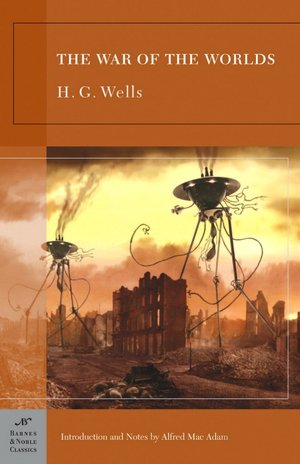
So, lately I've been listening to this:
Which lead to me reading, for the first time, this:
While thinking about running:
Yet at the same time I'd like to run:
Where this:
Has always been associated with:
And I'm really excited to get this soon:

Now, post holocaust after the Martians is nothing new. The Aftermath rules suggest it and a later return of the Martians was the ruin for one of their playtest games (even including the human hunters of men the artillery man envisions). Still, the idea of a devastating Martian war where humanity, but not civilization, is saved by monsters and magicians could be fun.

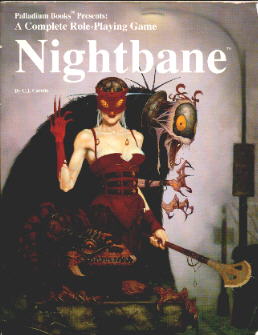
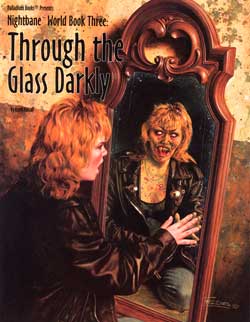
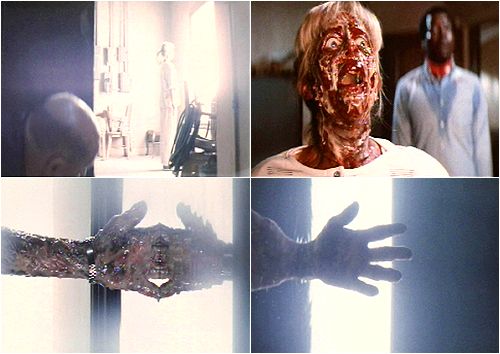
Base on The World After and this, among others, it's clear I've internalized the D&D is the apocalypse trope. It's also clear that I prefer it not be nuclear war and have a strong bent on the Devil did it (the multiple images above, for those who don't recognize them, are from Prince of Darkness).


Monday, July 30, 2012

Monday Pointers, 2012.07.30/NCurve Edition

D4: Drow I could get behind
Like a lot of people I'm elfed out and looking for alternate types. So, making use of my all time favorite sci-fi bad guys...hell yeah.

D6: Visual Appendix N
Although I'm not a huge fan of movie/TV references to ground a campaign I look at this and think, "Can I play?"

Sunday, July 29, 2012

Playing with History

Influenced by a old Jeff Rients post and prompted because the third has been on my mind today and the second the past week (actually about a week ago, but just finishing the post) here are some pseudo-historically based campaign ideas I've had:

PeriodCampaign IdeaNotesProbable Rules
About 110,000Clark Aston Smith's Hyperborea set in Sangamonian interglacial period GreenlandWhen reading about Greenland due to reading The Tale of Satampra Zeiros I found this map and it's been the primary inspiration.Of all the ideas this is the one most likely to have me drag out AD&D and believe it or not, second edition. Second edition seems like plays much closer to what I've called Intermediate D&D which I played in the early 80s than full blown AD&D. Also, I've never really played second.
871 ADThe Viking conquest of Britain during the reign of Alfred the Great.Having long had an SCA persona who was a pre-Conquest Saxon Although for years he actually bridged the Conquest and went on the Crusades...as I spent time in I got more interested in Anglo-Saxon England. Afred's reign. Bernard Cornwell's The Saxon Stories would be the major literary influence. Lamentations of the Flame Princess for the non-advancing fighter and the very dangerous magic which would be the halmark of the invading Vikings in constrast to the clerics of the Saxons.
late 1400sThe Valley of Mexico just before the Spainish Conquest (and possibly during).This is the most recently inspired, by the pyramids episode of Out of Egypt which I watched on Netflix. I didn't realize that Teotihuacan was not of Aztec origin but in fact predates their culture. That alone sounds like an excellent megadungeon. Plus, Aztec culture, even the poor "I read Wikipedia and a overview book plus watched some TV" cultures that characterize D&D games (even ones based on the Middle Ages or Roman), is alien enough for most of the people who might play in my games to make it interesting.While part of me wants to do straight OD&D with this one I suspect Runequest of some form (I've got 2nd and 3rd edition as well as BRP and GORE on the shelves and I'm open to either Mongoose version, 6th edition, or Open Quest). More than the other three I'd like to use An Echo Resounding with this one. The Valley of Mexico is perfectly sized for it at 3816sq miles. Remember, in Pre-Columbia America there are no beasts of burdern or riding animals so distances will always be driven by foot speed.

Friday, July 6, 2012

RPG Free Association

Matt's excellent Pars Fortuna includes all new spells. Reading them to build a list of 1st level spells for a new game that includes no stock spells I came across Miner's Nose which is described as "This spell grants the target the ability to magically smell precious metals and stones within 30 feet."

I immediately thought of this:


From Comics.org:
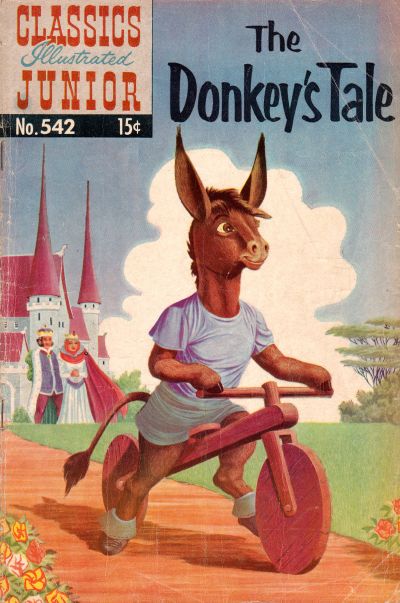
Once upon a time, there was a prince who was born in the shape of a donkey. He was the most beautiful, delightful, lovable little donkey in the world. But he was the saddest little donkey, too, for his greatest wish was to become a real human prince. Though he did not know it, there was one way he could become a human prince. But would he ever find the way?

The reason he was born that way was his father hired a wizard to help the barren queen give birth. When payment came due the king put copper at the bottom of the sacks of gold and the wizard smelled the different. Then the wizard cursed the child.

Outside of Scott at Huge Ruined Pile I don't see a lot of OSR people taking a lot of deliberate inspiration from fairy tales (this particular one is found in Grimm among other places). I don't know if Matt did here, but certainly his spell reminded me of a fairy tale (and wistfully...this particular comic was a favorite as a child).

Perhaps as much as Howard and Lovecraft we need to look at Grimm, Anderson, and Lang.


Monday, July 2, 2012

Monday Pointers, July 2, 2012

D4: Everchanging Book of Names
One of my favorite pieces of GM support software (in fact, one of only two RPG specific programs I use) is the Everchanging Book of Names. I have yet to see any OSR mention of it so I wanted to list it today. You can setup name parts and patterns that fit your world and let it generate away. Several books (sets of parts and patterns) are available include one for Greyhawk as well as other popular settings and literary sources. My favorite is, of course, Glorantha.

D6: Detailed Hexcrawl Rules
Justin has an interesting series of rules for running hexcrawls designed to keep the hexes behind the screen while players react to the environment.

D8: System Matters in the Sandbox
Ravencrowking has a multi-part discussion of why system aspects are needed for a sandbox to work. That he concludes the system in D&D 3.x and Type IV aren't conductive to sandbox play isn't a surprise. What I do find interesting is his conclusion on what currently available game beats out any version of D&D or retroclone for this position. By the reasoning he gives a retro-clone plus An Echo Resounding and Adventurer, Conqueror, King would meet the "best of show" standard as well.

D10: Nine Minute Campaign Design
Another one of those quick questions to get your setting down post that I've found useful.

D12: Crowd Funding by the Ton
Lamentations of the Flame Princess is trying to crowd fund 19 separate adventures. There are bundle options where you can get all that fund for much less than buying print plus pdf for each individually. If you are a Pembrooktonshire Gardening Society there are discounts on the bundles. It is Indiegogo, not Kickstarter, which means you pay upfront and get refunded if they don't fund. Given my two favorite OSR companies (LotFP and Sine Nomine) are effectively teaming up in it I'm most interested in seeing The House of Bone and Amber by Kevin Crawford (of Stars Without Number and Red Tide fame as well as the afore mentioned An Echo Resounding) although I'll be buying the bundle.

D20: Magical Pacts and Worshipful Machines
Speaking of Kevin Crawford we now have small free releases for Red Tide and Stars without Number.

Friday, June 29, 2012

Monster lists and the Sapir–Whorf hypothesis

So, Delta put up an interesting analysis of the LBB monster list, Original Monster Elegance. One of the things he noticed was the creatures were grouped by type and ordered, within type, by hit dice. You had humanoid types from half hit dice (kobolds) to 12 hit dice (giants). Similarly you had undead from half hit dice (skeletons) to 9 (vampires). In both cases the top monster had a variable range (8 to 12 for giants and 7-9 for vamps). After that you get, in Delta's words, a block of chimerical and serpent-like monstrosities, culminating with dragons, purple worms, and (on the flip) sea monsters.

Lately, I've been looking at the very common OSR idea of campaign unique monsters and spells. I wondered, what if you took the LBB groups and did the same thing uniquely. A group of humanoid monsters, a group of undead, and a group of...well, what do you call them, monster monsters.

There is this linguistic theory called linguistic relativity. Read the Wikipedia article for the detailed and not screwed up by me defition. I first heard of it as the Sapif-Whorf hypothesis in a Heinlein story (Gulf if memory serves). I've always understood it as "the words you have influence what you can think about" but Wikipedia tells me it's more complex than that. However, I think there is a kernal of truth.

See, when I was coming up with my three basic groups I was looking for a word to describe what Delta called "a block of chimerical and serpent-like monstrosities". Then, one hit me. I wrote down kaiju. At that moment, as silly as it might sound, just choosing the word to define the group of non-humanoid, non-undead monsters put it into focus. I immediately started thinking not only of Godzilla but Rodan and Gamera.

Maybe, in the end, the monsters won't end up that different. After all, they'll still be based on real animals in some way. I certainly don't want to create some "Japanese" setting. To be honest, if I wanted to use Japanese media as a primary inspiration it's more likely to be for a space fantasy game using Message from Space, The War in Space, Atragon, and so on. However, I do think choosing that word got me out of what I'll call the D&D mindset, the whole Elfy/Dwarfy thing.

Tuesday, June 26, 2012

Your Cleric is an Initiate

Most D&D style settings have a polytheistic religion that is simply either:

  1. An overly simplified Catholicism with the various deities being similar to saints.
  2. A modern mix of individual churches similar to Protestantism in the US.
I think we're missing a real opportunity.  While the first model is probably close enough to the state polytheistic faiths in the ancient and Classical worlds for the general faith of the people I think it misses the boat with clerics.

In the Classical world there were a series of religions variously known as mystery cults, mystery religions, or just mysteries.  Enough is known on two to even result in cult specific articles on Wikipedia: the Eleusinian Mysteries and the Mithraic Mysteries.  In fact, I wrote up a "race as class" version of Mithras a couple of years ago.

These cults were highly secretive and consisted of levels of initiation. The closest analog today is probably Masonic and similar orders as well as groups like The Golden Dawn. Based on that you might consider mystery cults to be more appropriate to magic-users.  While both groups are occult organizations the modern groups rely on intellectual understanding of the universe being increased instead of a divine revelation.  Both fit well in a campaign.

"But Herb," I hear you say, "how does this differ for being a follower of the god Foo in traditional D&D terms."  The biggest changes are social although some powers issues come up.  In the traditional D&D world your know that Foo's worshiper are healers so that's the temple you go to for healing.  With mystery cults you don't know much if anything about the faith including what powers they bestow or where to find a high priest of Foo or even the site of Foo worship.  In fact, even a PC cleric who is a member of Foo's mystery cult won't necessarily know the powers of those above him especially those significantly above him.  Thus, the indulgence system of gaining clerical favors (go to the temple and make a donation) is replaced with a series of investigations, favors traded, and possibly initiation for PCs.  Remember, much of the cult knowledge is secret and cannot be taught or shared.  This has ramifications for PCs (see below).

In terms of powers the customization would be similar in some ways to AD&D2 but different in others.  Instead of assigning schools to a given cult I would recommend drawing up several circles of initiation.  Each circle could consist of a mix of myths, symbols, titles, and spells becoming available as well as qualifications.  While certainly a level component should be part of a circle change other activities, such as quests or ritual combat similar to the Druid, the Monk, or the Paladin regaining status could be included at the higher levels.

One important idea is don't have the spells map to 2nd edition and later domains.  Mystery cults don't map well to normal deities of the "sun god", "rain god", "war god" style.  They are much closer to early conceptions of cults in Runequest.

The other important idea is secrecy.  Sure, your third circle cleric of the Foo mysteries recognizes that symbol as the sign of Bar from the myths of the Snafu over the wedding feast but you can't communicate those details to the party with risking a religious violation.

To give an example of circles, tomorrow I present my Initiate of Mithras as rules for a cleric.