Tuesday, January 5, 2010

Two TARGA Ideas

Below is the body text of a message I put out on the TARGA list this morning. Given it addresses issues I've brought up on this blog I figured posting it here would be worth while as well:

While at the theater to see Avatar I saw two promos that could be of
interest to the TARGA crowd: the remake of Clash of the Titans and the Russel Crowe Robin Hood. Before on the blogs the idea of handing outthe S&W Quckstart at the next Harry Potter movie was bandied about a bit. Why not consider doing the same for either of these movies, but especially Clash of the Titans. Or work with the Mazes and Minotaurs gang to do a version of it aimed at that movie.

Coordinating a "TARGA night at the movies" by gathering PDFs and how to articles (such as how to get your local theater to allow it, how to work with the local Amtgard group's demo, etc) would, to my mind, be a very useful thing for TARGA to do.

The second idea is official or recommend TARGA table rules. Not game rules, but behavior rules, such as those Chess and Bridge organizations have. We're not tournament gamers so they wouldn't need to be as strict. I recently posted on gamer behavior on my blog, following up on some other people's discussion of it, and got a lot of response. I think this is another area where TARGA could take the lead and help the hobby. Simple things like being out front about not putting up with that one guy at our tables could go a long way in
setting an example.


Questions? Comments?

Monday, January 4, 2010

One in 1250

One question that has come up with my recent post on rudeness hurting the hobby is what the benefit of role playing games being viewed as an adult hobby would be. In fact, at least one poster argued it would be a bad thing sending us to the least common denominator even in behavior, which I find hard to even consider. The most interesting fire it sparked, however, was over at D&D with Pornstars claiming the hobby is about the right size, specifically the DIY part. Zak even argues more people means more assholes. While that is a truism in the same sense that more people means more eyeballs I don't think it would increase the ratio in general.


These are all valid points so I think it's time to take a step back and explain some of the logic behind my "grow the hobby" posts. I'm also inspired to do that by something I found in my old game collection when I went home for the holidays. I was looking through one of my favorite issues of Strategy & Tactics. The issue is 49 from 1975. The issue game is Frederick the Great which is easily one of my top five hex and chit war games and top twenty-five games periods which is why it is one of my favorite issues.


For those not familiar with Strategy & Tactics it is a military history magazine that comes with a complete wargame in each issue (or did, you could get it sans game and it is sold that way at bookstores today). In the 1970s it included a post-paid bubble card. The last two pages of each issue had a variety of questions ranging from basic demographics to opinions on existing games to game proposals to be rated. Readers sent it in and the numbers were crunched. It was probably the only genuine long term market research in the history of the broad gaming hobby. Even if not unique I would bet real money no one has been more through. Each issue reported on prior issues feedback answers with most space being devoted to how the game proposals rated and which would be put into the production cycle.


In issue 49 there was a discussion of the demographics of the hobby. I doubt anyone today from the newest gamer to the oldest grognard would be surprised by most of it. Hex and chit wargaming at the time was overwhelmingly male and young adult to early middle aged. The gamers were mostly college educated and more urban and suburban than rural. It goes on to discuss some regional breakdowns and other issues but most striking were two numbers. They feedback lead to a conclusion that there were about 400-500 people per 1,000,000 who played SPI games with about another 200-300 who played hex and chit games but not SPI products. If we add those numbers together we 6-8 hex and chit wargamers per 10,000 of population. While hex and chit wargaming still had some growth left before it peaked in the late 70s I think this number is close to the sustainable number of hex and chit gamers. I also think it is a good first estimate of the sustainable number of role playing gamers for a variety of reasons not the least of which is how many role playing gamers in the late 70s boom came from this population. In fact, D&DD would show up in the feedback list of games to rate regularly in the late 70s and SPI would produce two rpgs in the early 80s, Dragonquest and Universe.


So, when I talk about growing the hobby I'm talking about having between 200,000 and 300,000 people in the hobby of whom about 125,000 constitute a stable core of series roleplayers. More importantly, I'm talking about that stable core being composed of a group with somewhat similar demographics to the hex and chit wargamers of the 70s. While I wouldn't want to see us going back to being as male as we were in the day I wouldn't mind seeing us reading as much as that group. As I have said before I believe role playing is a literary hobby and that the hobby is healthier when its primary inspiration is written as opposed to visual.


The ironic thing is we had that in our grasp thirty years ago. As I argued in the rudeness post a huge reason we lost it was the marketing of rpgs to teens and tweens exclusively. A second was TSR's mishandling of their takeover of SPI. There were others but the only one that matters today is rudeness and kid image of the game. Thanks to the internet the core of role playing, a creative gaming hobby, has a second chance to be what it could have been. That to me is the real magic of the OSR. It can be the seed of a redo that brings those members of that eighth of a million people who are currently writing novels during NaNoWriMo or painting dragons or cross referencing the Dark Tower series who think D&D is for kids back home. When I recruit for a new game these are the people I want to attract and play with for what I think are obvious reasons. If the price of bringing them to us is telling the children of all ages to grow up and behave I think it is a trade worth making.

Wednesday, December 23, 2009

Inspirational Art: Mithras

This week's Inspirational Art is a departure. It doesn't a cover a single artist but a single subject. It is also historical more than fantastic.


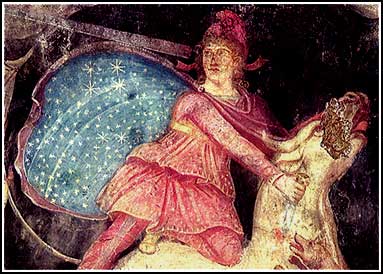
Mithras was the subject of a mystery cult common in the Roman Legions during the Imperial period. Also know as "Mysteries of the Persians" it first appears in Rome in the first century AD. While the figure of Mithras carries a Persian name it is open to debate if this religion was imported from Persia or created in Rome out of bits and pieces of Persia and other lore.

The image above is called the tauroctony and was the central image of Mithratic sites. The image depicted is the ritual slaying of a bull although the meaning is open to debate (you'll see this phrase a lot in studying the Mithratic Mysteries). The interior of his cloak is lined with the cosmos and it is commonly believed that the symbolism is astrological. The image below is of the other common Mithratic iconography, the banquet. It portrays Mithras feasting with the Sun on the hide of the slaughtered bull.


Mithraism, along with the other mystery cults, offers a grand pattern for Dungeon Masters to add a unique religious element to their game. One reason we know so little of the religion is the nature of mystery cults. They have multiple levels of initiation with secrets taught at each level, not unlike some modern groups like the Masons. With Mithraism we even have the names of the levels: Corax (raven), Nymphus (bridegroom), Miles (soldier), Leo (lion), Perses (Persian), Heliodromus (sun-courier), and Pater (father).

Imagine a variant cleric class with spell lists and powers keyed to what little we know of Mithras (or some other mystery religion) using the initiation stage names as level titles and powers that evoke the name.

Tuesday, December 22, 2009

Miss Manners Wouldn't Play D&D

Some rules I have encountered in my travels:

  • Refrain from making negative comments during play concerning the contracts made.
  • Always pay attention to the play and stop your mind from wandering.
  • Making a questionable claim or concession is inadvisable.
  • Don't prolong the play unnecessarily.
  • To vary the normal tempo of bidding or play in order to distract opponents is not recommended.
  • Do not leave the table needlessly before the round is called.

While a few of you might be able to guess what these are for I suspect most of my readers won't. They are taken from Bridge: Rules of Etiquette by David Braybrooke.

You are probably asking one of two questions and possibly both. The first is "why am I bringing up contract bridge in an RPG blog?" The second is "why am I bringing up rules of etiquette in an RPG blog?" The answers are "because bridge is commonly seen as a game for adults" and "because RPGs aren't" respectively. Last week I discussed how TSR's marketing choices moved D&D into being primarily perceived as a kids game. Today I'd like to discuss what I consider the single biggest obstacle to changing that perception; role-playing gamers as a whole have horrific manners.

Before you contend I'm alone in my thinking or that I'm merely subscribing to gamer stereotypes let's look at the evidence. While I had considered this before the topic was rammed home by two postings in the RPG community. The first, and more acerbic of the two, was by Alexis at The Tao of D&D and was titled DM As An Asshole (a how-to guide). The RPG Rules of Etiquette he laid out were very strict and drew on his experience as a chess player, specifically tournament play. However, strict as they are he correctly points out that they are common for many activities such as yoga, theater (performing or attending), and even playing in some musical ensembles. About two months after a similar post was made at RPG.net entitled Critque my table rules by D. Archon.

As for gamer stereotypes, I am indulging them. If we want to move RPGs back to an adult hobby from a kid's hobby which for any niche hobby is vital to its long term survival, we need to confront these stereotypes on two levels. The first is most people have them. The unwashed, mouth breathing, obsessed with his 70th level Paladin/Mage/Dungeon Master and the S&M elf chick that character is having sex with is the broader view of the hobby. Alexis is right. That is exactly what your coworkers are thinking when you walk away after talking about what you did this weekend. They may not think it of you specifically, but even then they wonder why you put up with people like that and what's wrong with you. To claim the same respect hex and chit wargaming had in the 1970s, an acceptable adult hobby even if not for everyone, we need to correct this image.

Before you start writing Alltel or the guys who write whatever sitcom dumped on gamers this week we need to clean up our own house. The fact is the matter is Alexis only went part of the way when he said, "D&D has consistently been, in my experience, the second worst offender when it comes to poor manners, poor habits and unbelievably infantile self-proclaiming posturing. The worst, of course, is any bar with a television where you’re trying to get solemnly drunk." The reality is too many of us not only accept this but celebrate it. When you consider the most popular gaming comic out there, Knights of the Dinner Table, this is driven home. I love the Knights and identify too much with the comic. That is part of the problem. Three different tables are regularly featured and at best one of them has a majority of functional adults at the table, Patty's Perps. To even bring them to that status of majority functional adults we have to include an ex-con as functional. That an ex-con trying to go straight is more functional that all but one of the lead group's players (the only functional adult in the Knights is Sarah) says something. Before anyone says, "but it is just a comic", they should come up with a reason for it being routinely funny and very popular that doesn't involve it reflecting the hobby as a whole.

If you need a more real world example let's return to D. Archon's table rules at RPG.net. Despite being milder than Alexis's rant there were multiple objections to rules I would consider fairly common sense. Some examples that people thought were "bring your own stuff" and "be on time or call". When you're 14 these are common issues that you put up with. When you are 25 or 35 or 45 or beyond and trying to squeeze gaming in along with a full time job, grad school, spouse, kids, maintaining your house, and so on the behavior being explicitly prohibited should not even come up. Even more disturbing, for me, was how much of myself I saw in both lists and how, with one exception (being on time, which is an ongoing personal struggle), they are mostly gaming specific.

The fact is we don't act like chess, bridge, or hex and chit gamers. We don't model their public and tournament play in our public and tournament play nor do we model their casual play in our casual play. We have more in common behaviorally with science fiction fandom. Even adults who love fantastic literature and media often avoid fandom. For the same reason, a large number of adults who love the literature and media that inspire us and love to create stories avoid our hobby. Not only do they avoid it but actively consider it in a negative light.

Yet that occurs in a world where one of the most influential figures on TV, Stephen Colbert, an NBA player, Tim Duncan, and some popular actors, Robin Williams, Mike Myers, and Vin Diesel, are all one of us. As I wrote last week this could be the real golden age of the hobby. It is older than it's been in two decades in terms of players, fantastic media is on the upswing, some prominent people are players, and we are returning to our DIY roots as DIY is on the upswing again. Let we are still considered a childish hobby. If we want to begin to reverse that trend and take advantage of all the possibilities to carve out a place as a stable, adult, niche hobby that will be around for our old age and our grandchildren the first step is to act like adults. Hell, in this day and age that might be another groundbreaking creation of the hobby.

2d6 Expldding on Doubles

What are the odds of scoring any value three through 20 on 2d6 if they explode on doubles? This, is of course, the same as saying "what are the odds on a T&T Saving Roll?" Because I'd like to convert the thief's skills to T&T style talents I needed to come up with values for levels one through 20. I'd have to look up the math to do an exact probability calculation so I wrote a Perl script to do 1,000,000,000 simulations instead. The results for those who are interested:


RollOddsOdds <=Odds =>
38.0%8%100%
48.0%16%92%
516%32%84%
616%48%68%
717%65%52%
89.0%74%35%
99.7%83.3%26%
101.3%84.6%15.4%
112.0%86.6%13.4%
121.4%88%12%
132.1%90.1%9.9%
141.4%91.5%8.5%
151.9%93.4%6.6%
161.2%94.6%5.4%
171.3%95.9%4.1%
180.1%96.9%3.1%
190.1%97%3%


Twenty was under a tenth of a percent even rounded so I excluded it.

Wednesday, December 16, 2009

Inspirational Art: Natalia Pierandrei


This week we return to Deviant Art to find a source of inspiration. A first, however, for the Inspirational Art series is actual RPG art.


Natalia Pierandrei says At the End of the World is "Concept art I'm doing for a RPG set in Victorian Age." Certainly it's enough to make me want to check out the project, but then again I have a weakness for Steampunk/Neo-Victorian/Neo-Edwardian settings, especially the kind often seen in anime that unselfconsciously mix magic and multiple technical levels. It's probably the airship thing.


While she is at Deviant Art I'd suggest following up with Natalia at her own website, A Forgotten Night Tale. She notes she is available for freelance and specifically mentions RPGs. My friends in the OSR who find her work compelling might contact her for that next big thing you're working on.

Tuesday, December 15, 2009

Not a Golden But a Gilded Age

Although it overlaps ages in James Maliszewski excellent D&D chronology the period from 1981 to 1985 is generally considered the golden age of D&D and of RPGs in general. People generally say the early 1980s but I'm putting in specific dates for a reason. They represent the beginning and the end of the worst thing to happen to our hobby. The opening year is the release year of the Moldvay Basic set which is generally seen as the classic version of Basic D&D. The closing year is the year 60 Minutes ran its now famous expose about the game. They also serve as rough bookends for D&D as a fad. The damage of that era is due to how TSR choose to mass market D&D. Unlike many OSR members I do not think that appealing to a mass or broad market in and of itself is destructive to the hobby. The sin against the broader hobby TSR committed was marketing to kids


The Moldavy boxed set reads "The Original Adult Fantasy Roleplaying Game For 3 or More Adults Ages 10 and up". Contrast that cover information with the earlier Holmes boxed set's test that read "The Original Adult Fantasy Roleplaying Game for 3 or more players". The original boxed set had no age information on it.


For those who weren't around in the era you need to understand a few things about games in that time frame. Games for adults, especially in the mass market, were generally party games. Hobby games were mostly hex and chit wargames sold in hobby shops and for some peculiar reason I've never learned Avalon Hill games were commonly found in Hallmark stores. Board games were mostly kid or family oriented games. Major game publishers indicated the target market for their games with lines like "suitable for ages 10-14". In choosing ages 10 and up for their marketing TSR was making a conscious choice to market D&D to tweens. By 1983 and the Mentzer set TSR had dropped any pretense of marketing to adults by removing the word itself from their mass market oriented age range. The Mentzer Basic read "Ideal for 3 or more beginning to intermediate players, ages 10 and up". Star Frontiers, Marvel Superheroes, and other TSR games would bear the same age range in that period.


This had a series of perverse effects. First, adults who even three years earlier might have been open to the game were lead to perceive it as a "kids" game. Second, by marketing to the fickle children's market TSR was choosing a ton of revenue today in exchange for sacrificing a steady income stream in the long term. The worst damage, though, was to both the kinds of kids who were playing and the nature of the groups they played in.


I've written before about the value to teenage players of being accepted into an adult peer group as an adult. Testimony from people who started playing as a teenager in the era of 1975-1985 is quite interesting. Those who stayed in the hobby tend to have been their group's kid while. Those who were in peer group games seem to have left during and after high school. A handful are now coming back in their late 30s and early 40s. I have no hard statistics to prove it, but I suspect most of the former stayed and most of the later left to never come back. Peer group players were taught the same thing adults were taught by the box ages, this is something for kids not adults.


That is the true damage TSR committed and it is both deep and far ranging. Listen to this story from NPR's All Things Considered about the release of third edition. The story talks about designers trying to appeal to a new adult fan base. Anyone with a clue about the hobby knows most third edition books were sold to adults who had been playing for decades. This association of D&D with kids is a huge part of the negative geek image the hobby has. To the average adult choosing to be involved in a kids game puts you in the same category as comic book guy from the Simpsons. For example. just two years later the same show would run this story for the thirtieth anniversary. As you listen to the tone in parts of that story you are paying the interest on all that money TSR made. The surprise that adults still pay a kid's game is palpable.


The sad thing is that TSR could have chosen another path to a broader audience. In that version of the past D&D never becomes the fad it was but remains an adult hobby. The mass marketing moved into Hallmark stories along the lines Avalon Hill games or into mass market bookstores aimed at adults. In that world TSR probably still exists and Avalon Hill probably does too. That marketing, after all, marked the hobby as whole and just roleplaying as a kid's hobby. We'd still be different but in the way chess players and amateur painters are today and wargamers were in the 1970s. Do not underestimate the changes to our hobby, internally and externally, that acceptance as an adult hobby would have.


So, I don't consider the mass market era a golden age. It was a gilded age that hurt the hobby for two decades. The silver lining is some of the players who played as a teen and left at adulthood are coming back. The indie movement of a few years ago, the OSR, and even WotC's targeting of people in their 20s with both of their editions of D&D all are doing today what TSR could have done then. The hobby survived long enough for use to get a do-over. Having seen the error of appealing specifically to children we can now appeal to adults, even those 10 and above.

Monday, December 14, 2009

Crosslink: Death Frost Doom infiltrates WotC

James Edward Raggi IV got the most surprising plug of all for his excellent Death Frost Doom.

Mike Mearls plugs it on the current official D&D podcast. You know, the one from the company that makes Fourth Edition.

Get the link at Lamentations of the Flame Princess

Sunday, December 13, 2009

Are Horror RPGs Possible?

So, today I finally watched the original version of The Wickerman having had it from Netflix since before Thanksgiving. While watching it I was reminded of a time when horror meant something other than gore porn which alone was worth the time. It also brought back memories of very frightening thriller horror from that time period focusing on witches and satanism as well as pagan.

Like many gamers it made me want to get out some horror rules (specifically the first edition of Palladium's Beyond the Supernatural) and plot out a campaign. But I was stopped fast.

Can you really create a horror RPG campaign that will be fulfilling for both players and the game master? It is certainly possible to create a mood of horror as Death Frost Doom shows. Consider this, however, in horror there are generally few if any survivors and most horror films, especially of the more thriller type, leave a suggestion if not an outright demonstration that the leads have failed in ending the horror.

As a result we have to create action horror games. Sure, we have horrific events and a variety of supernatural and normal horrific events. That said, from the earliest horror games such as Stalking the Night Fantastic, Chill, and the afore mentioned Beyond the Supernatural you were a very competent individual who stood a chance of defeating the horror for good while surviving. Even the game that began horror as a genre, Call of Cthulhu was more August Derleth than H. P. Lovecraft for this reason. The other path, mostly as a result of White Wolf's Vampire and its success although also see in Stellar Games's Nightlife is you playing the monster.

In the end the best we can do is something like Call of Cthulhu which intersects with horror in a more TV than movie space (I don't feel qualified to comment on horror literature having limited exposure). CoC investigators, with their regular success and survivability are more akin to Kolchak: The Night Stalker and The X-Files (especially the pre-mythology conception of the show) as well as Derleth's The Trail of Cthulhu.

In that way, I think the development of those games has hurt RPG horror. While a horror campaign is probably not possible the proliferation of a "horror light" mentality and horror mechanics to enforce the mood has dampened the ability to bring horror as a style for certain adventures. It has encouraged us to think of horror as sanity points and monsters who eat them (instead of hit points). Horror should be a feeling of doom and that, even if you get out alive, you somehow didn't win.

Friday, December 11, 2009

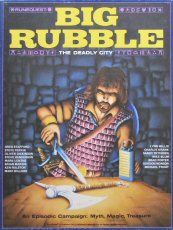
Buried Treasures: Big Rubble, The Deadly City

The BIG RUBBLE is the perfect hunting ground for both prospective and veteran adventurers. From the relative safety of the frontier town of New Pavis, exploration parties may venture forth into the Rubble to once again tap the treasures and magics buried in its ruins. They will be aided and hindered by the guards and bureaucrats of the occupying Lunar empire.


Recently there was considerable discussion in the OSR about the ability to publish a mega-dungeon. Some, such as James Maliszewski over at Grognarda, didn't think it could be done. Other disagreed including Michael Curtis over at The Society of Torch, Pole and Rope who published his Stonehell soon after. One constant in all the discussion, however, was the conclusion the attempts at publishing one of the classic mega-dungeons like Blackmoor or Greyhawk had all failed. While that might be true at least one early structure that should qualify as a mega-dungeon did see the light of day. In fact, it had two published boxed sets cover it and the associated city which still garner high prices on eBay and were reprinted as one massive book in the 1990s. That mega-dungeon is the Big Rubble, the ruins of the city of Old Pavis in Glorantha.


For those who are wondering why you have never heard of Pavis or The Big Rubble along side the Slaver, Giants, and Drow modules the answer is simplicity and fate. Pavis: Gateway to Adventure and Big Rubble: The Deadly City were published not by TSR but by Chaosium. They are not for D&D but for Runequest. I find it ironic that the game that in its day was considered the anti-D&D published the most successful mega-dungeon of the period. Both boxed sets were among a series of supplements, mostly boxed sets but some booklets, that represented the golden age of Runequest and, in my mind, of Glorantha as a game setting. Anyone interested in early campaign styles that started to add loose plotting to great sandbox settings should look at most of these sets.


What is the Big Rubble? It is a the ruins of two cities the later of which was about sacked about 400 years earlier. The first city was founded about 900 years before the supplement begins by a culture of evil magicians to capture magical cradles carrying giant babies to the sea to join in the battles of Glorantha's mythological age. It only lasted twenty or so years before being destroyed by a giant and his allies who included a minor god. They built the towering walls (80 feet plus in height) of Old Pavis to use as a fortification. About thirty years later a man named Pavis, whose city was sacked by the same minor god's followers, lead a giant, faceless statue and some nomads to take the fortifications. After the battle the statue was used to build the interior buildings. Pavis himself would later become the city's patron deity but the city would be sacked by trolls around 400 years after its founding.


A game master opening the Big Rubble boxed set could look forward to "thousands of acres of ruin and destruction now remain, full of robbers, outcasts, and inhuman monsters." To get an idea of the scale consider the image to the left superimposing both the old (larger) and new (smaller) city on modern London (the original source has one imposed on Manhattan as well). The white area outlines medieval London contrast. No attempt was made to detail all of this area. Instead a 48 page "Rubble Guide" details some highlights of the area. Nine scenarios detail such a maze-like canal built for seemingly no purpose to a troll town hiding a magical artifact and everything in between. Plenty of notes are provided to help the game master build his own sections of the city. Finally, some forms used by officials in the new city to control exit from the rubble to the new city are included.

So, you can publish what amounts to a mega-dungeon. You can especially publish an adventurous, mostly above ground, one rooted in unique mythology. You can even create one of our hobby's forgotten masterpieces in the process.