Showing posts with label buried treasures. Show all posts

Sunday, February 20, 2011

Lost post: Okay, another project to not get around to...

In looking for links I found this draft which I thought I'd actually posted. It's the genesis of the never really followed through which means the title was very accurate. Still, I figured it was worth posting as I have yet to see anyone discuss the kinds of books I brought up. Plus, Diadem of the Stars has been staring at me as I get ready to run Stars without Numbers at the D&D Meetup.

Over at Grognardia the wonderful Mr. Maliszewski asked for review suggestions.

Inspired by having recently purchased Jo Clayton's Duel of Sorcery I suggested reviews of fantasy contemporary to the early editions of D&D because it became incestuous with fantasy fiction. There were, after, a lot of fantasy writers active in the 70s and early 80s who wrote neither pulp fantasy (which was the primary D&D inspiration) or Tolkien pastiche. Some fine examples are Bradley with her Darkover novels, Andre Norton who wrote a great number of Witch World books in the 70s, McCaffrey's Pern, the afore mentioned Clayton and her numerous series (Diadem from the Stars (Diadem, Bk. 1)
was first published in 1977), the Deryni books, LeGuin's Earthsea (and her excellent "The Language of the Night", essays on fantasy writing well worth reading), Xanth, and the entire Ballentine Adult fantasy line (some of which did influence D&D).

The reason I asked is one thing I've realized in getting into the old school movement (and I remarked on this when discussing why "Swords of the Red Sun" failed) is my D&D experience wasn't fueled by Conan et al. The more important realization was my inspiration comes from another line of fantasy (excluding my love of John Carter and his descendants) but something different. When I first got my basic set I read mostly sci-fi and looked for fantasy to fill the gaps. As currently hot I read lots of Pern, Darkover, Witchworld, and so on. While some might argue romantic fantasy owes its roots to these authors I'm disinclined to put them in that school.

Regardless, there are an equally valid influence for old school gaming in the sense that those of us who played back then read them. James said it would be a useful project but passed on it saying he lacked the knowledge (and, although he didn't say as much, I suspect interest in acquiring it).

Thursday, July 22, 2010

Buried Treasures: Old School RPG Magazines and Fanzines

Because I can't keep track I thought I'd create a list of RPG fanzines and magazines dedicated to pre-3.x D&D, clones of it, and T&T. Images are the most current issue. The order is not meant to be a comment, but just reflects the order I remembered them.


If I missed your magazine or you'd like the link or thumbnail changed please drop me a line. I'm only interested in those still being actively produced (I'm unsure of the status of Green Devil Face so I didn't list it).

Tuesday, March 30, 2010

Buried Treasures: Hellpits of Nightfang

If I was going to give a new Dungeon Master of any edition of D&D, yes even 4th edition, a module to say "hey, here's how it is done" I have to admit it wouldn't be from TSR. In fact, it wouldn't even be a D&D module but a Runequest one. I'd hand him Hellpits of Nightfang by Paul Jaquays and published by The Judges Guild. Fortunately I still can as it is available as a PDF for under $3.

Hellpits of Nightfang details a set of three limestone sinkholes and the caves and tombs attached to them. The pits serve as the home to a pair of vampires and a pack of wolves as well as some other creatures. It has fifteen number locations which are all named as well which adds some character. While the entire module is thirty-six pages long much of that is white spaced lined for notes, especially as part of stat blocks. Major characters (the two vampires and one wolf) take about a page for blocks with note space while minor creatures run as many as five per page. A very brief history of the two vampires and the hero's tomb in the sinkhole is provided.

What makes Hellpits of Nightfang an ideal model for a new Dungeon Master? First, it is a quintessential location adventure. It has absolutely no plot. In fact, I can summarize the entire background knowledge in three sentenses. Nightfang is a vampire so old his real name is forgotten even by local villagers. In life he was a priest of a death cult and sacrifices his victims to his god meaning he rarely creates vampires. The one exception was the ugly daughter of a local farmer he has turned. The sinkholes also include the tomb of a local hero but since it was built the weather has gotten wetter and the tomb floods. That's it. The only mention of anything beyond the pits is a local populace including at least one farmer now short an ugly daughter. It is a prime example of creating something and let the player's action define the story.

Second, Jaquays used a standard format that had earlier been used in Snakepipe Hollow. I find it creates a much more open feeling than many TSR modules in the same period used. It also provides a fine teaching setup by suggesting the difference between designed set pieces and more dynamic locations. While some might object to the amount of detail in the context of a beginner I think adopting this format would be a huge help. It is a prime example of expert created rules that might stifle experts forced to use them but that provide a marked advantage for beginners.

Finally, the adventure has some interesting set pieces. Without giving too much away Nightfang has some interesting items and ways of using them you might not consider. The flooded tomb has a very interesting pool. There are also some interesting traps of a type I've yet to see in many OSR discussions.

All in all, this is an excellent adventure. While a classic location adventure it provides a lot of contrast to many modules. It is small enough to wrap your head around the whole thing and see how it is put together. I think it is an excellent first adventures for a new Dungeonmaster, especially of the old school.

Friday, February 12, 2010

Buried Treasures: Mechanoid Invasion


When I went home for Christmas I looked through my games collection that still resides at my parents' house. Among the items I found in boxes that I was very glad I still had was the first roleplaying game Palladium Publishing produced, The Mechanoid Invasion and it's two sequels.

For those not familiar the series of three games/supplements describes the destruction of a human colony by the Mechanoids. They Mechaniods are an evil, insane, race of cyborgs. Think of the Borg but created while on a peyote trip after reading a decade of Rom: Spaceknight comics. In the first book, The Mechanoid Invasion the colonists are trying to fight off the Mechanoids. In the second book, The Journey, finding out that military assistance will be month's too late as the Mechanoids are tearing apart the planet for resources the colonist become the rats in the walls of the Mechanoid's asteriod sized mothership. Interestingly, this book is the only one that is isn't a stand alone game. Finally, in Homeworld, we reach the Mechanoid homeworld. The last is the longest book at 192 digest pages. The combined reprint is in normal RPG sized is about 200 pages.

Today Palladium has become the butt of jokes for most of the community for their gun porn, power creep, and recycling material. There is truth to that. In fact, if you get the original The Mechanoid Invasion you'll find material in the newest Palladium games word for word. Even in the third book you get material for the first repeats. The Balrog Destroyer super tank from The Journey is the first instance of the power creep and lack of internal logic that would characterize Rifts material.

However, ever good thing that people would say about Palladium in the next thirty years is in here too. The engine, which is an early D&D derivative, is functional for the game in place. Given the modern view that the Palladium engine is fine for fantasy but broken for modern systems people should look back. The gonzo imagination of Kevin Siembieda is on display. The various kinds of Mechanoids is creative as is the entire idea of the second book. At the time most people expected what we'd later see in Rifts with the Federation showing up with big ships and a power scale up. Instead we got microbe created magic and the ultimate reverse dungeon in space.

After the original digest books went out of print Palladium created a third stand alone game called The Mechanoids set between the first and third book of the original trilogy. While not quite as exciting it isn't a bad game. A decade later the Mechanoids would appear with mega-damage as yet another Rifts supplement. This is the least enjoyable version in my opinion but for several years was the easiest to find. However, about a decade ago the original books were gathered into a single volume pretty much intact. This big book is one of Palladium's first e-products and is available at RPGNow. The preview has a complete table of contents if you're considering any version of the reprint.

With the growing interest in science-fantasy this is truly a buried treasure. If you are using Mutant Future including Mechanoids in a variety of forms is an option. They'd fit well into Encounter Critical. I'm not sure they'd be too great for most science fantasy but I'd encourage someone using Jeff Rient's Alchemical Proposal to think about making it one supplement. In fact, if you want to do an OSR science fantasy game more from the science side than the fantasy side it it could be a good base game. Regardless, this is one game worth overcoming the post Rifts Palladium prejudices to take a look at.

Friday, December 11, 2009

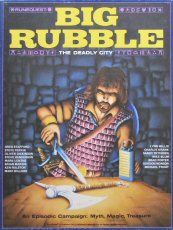
Buried Treasures: Big Rubble, The Deadly City

The BIG RUBBLE is the perfect hunting ground for both prospective and veteran adventurers. From the relative safety of the frontier town of New Pavis, exploration parties may venture forth into the Rubble to once again tap the treasures and magics buried in its ruins. They will be aided and hindered by the guards and bureaucrats of the occupying Lunar empire.


Recently there was considerable discussion in the OSR about the ability to publish a mega-dungeon. Some, such as James Maliszewski over at Grognarda, didn't think it could be done. Other disagreed including Michael Curtis over at The Society of Torch, Pole and Rope who published his Stonehell soon after. One constant in all the discussion, however, was the conclusion the attempts at publishing one of the classic mega-dungeons like Blackmoor or Greyhawk had all failed. While that might be true at least one early structure that should qualify as a mega-dungeon did see the light of day. In fact, it had two published boxed sets cover it and the associated city which still garner high prices on eBay and were reprinted as one massive book in the 1990s. That mega-dungeon is the Big Rubble, the ruins of the city of Old Pavis in Glorantha.


For those who are wondering why you have never heard of Pavis or The Big Rubble along side the Slaver, Giants, and Drow modules the answer is simplicity and fate. Pavis: Gateway to Adventure and Big Rubble: The Deadly City were published not by TSR but by Chaosium. They are not for D&D but for Runequest. I find it ironic that the game that in its day was considered the anti-D&D published the most successful mega-dungeon of the period. Both boxed sets were among a series of supplements, mostly boxed sets but some booklets, that represented the golden age of Runequest and, in my mind, of Glorantha as a game setting. Anyone interested in early campaign styles that started to add loose plotting to great sandbox settings should look at most of these sets.


What is the Big Rubble? It is a the ruins of two cities the later of which was about sacked about 400 years earlier. The first city was founded about 900 years before the supplement begins by a culture of evil magicians to capture magical cradles carrying giant babies to the sea to join in the battles of Glorantha's mythological age. It only lasted twenty or so years before being destroyed by a giant and his allies who included a minor god. They built the towering walls (80 feet plus in height) of Old Pavis to use as a fortification. About thirty years later a man named Pavis, whose city was sacked by the same minor god's followers, lead a giant, faceless statue and some nomads to take the fortifications. After the battle the statue was used to build the interior buildings. Pavis himself would later become the city's patron deity but the city would be sacked by trolls around 400 years after its founding.


A game master opening the Big Rubble boxed set could look forward to "thousands of acres of ruin and destruction now remain, full of robbers, outcasts, and inhuman monsters." To get an idea of the scale consider the image to the left superimposing both the old (larger) and new (smaller) city on modern London (the original source has one imposed on Manhattan as well). The white area outlines medieval London contrast. No attempt was made to detail all of this area. Instead a 48 page "Rubble Guide" details some highlights of the area. Nine scenarios detail such a maze-like canal built for seemingly no purpose to a troll town hiding a magical artifact and everything in between. Plenty of notes are provided to help the game master build his own sections of the city. Finally, some forms used by officials in the new city to control exit from the rubble to the new city are included.

So, you can publish what amounts to a mega-dungeon. You can especially publish an adventurous, mostly above ground, one rooted in unique mythology. You can even create one of our hobby's forgotten masterpieces in the process.