Monday, April 25, 2011
Throwing in the Towel...
I won't be finishing out A-Z. I'm out of steam and I think I'm better served by admitting defeat than phoning this week in.

Personal Appendix N: T is for Two to Conquer

Two to Conquer
 is another Darkover novel sharing a setting Hawkmistress, although considerably later time wise.
It has stronger science fantasy elements combined with a weird Prisoner of Zenda type plot. The book opens with Paul Harrell, a criminal sealed into a stasis coffin, being summoned out of it to Darkover. He is the unique duplicate of Bard di Asturien and has been summoned to provide his duplicate. Bard is one of two leaders struggling to unite the Hundred Kingdoms. The novel covers the beginning of their union under the Compact achieved not by Bard, who is the novel's principle character, but his rival Varzil the Good.
The book has several very game worthy ideas. The most interesting is the science behind not only the ability to summon Paul but why he had to exist: Cherilly's law. The law states "Nothing is unique in space and time except a matrix; every item in the universe exists with one and only one exact duplicate, except a matrix stone." A matrix stone is a stone native to Darkover (but also capable of being created) that amplifies psionic powers. Matrix stones and Cherilly's Law could be a magical idea that could propel an entire series of adventures or even be a cornerstone of a campaign. Imagine a megadungeon which made prominent use of this principle.
There are a couple of other ideas that jump out at me. Among things in the Compact is the outlawing of distance weapons requiring those who intend to kill to place themselves at risk. The other is the novel recounts the initial interactions between the the Priestesses of Avarra and the Sisterhood of the Sword mentioned in the Hawkmistress entry which leaders to the Order of Renunciations.
Monday Pointers
D4:Old School Prestige Classes
This could meld well with Zak's location based feats idea as well. Also, notice the blog itself is now part of the blogroll.
D6:Alernate XP
If I ever run True20 this might be what I use for advancement instead of the system Chronicles of Ramlar, despite the principle reason I own the later is its experience system.
D8:Magical Traditions
I like this quick and dirty way of determining spells for new characters. It would mesh nicely with the idea of having specialist magic-users from 2nd/3rd edition (easily portable to OD&D) be based on a tradition instead of a college. What if Hurgh's spells are forever banned to students of Rhialto due to incompatible theories of magic?
This could meld well with Zak's location based feats idea as well. Also, notice the blog itself is now part of the blogroll.
D6:Alernate XP
If I ever run True20 this might be what I use for advancement instead of the system Chronicles of Ramlar, despite the principle reason I own the later is its experience system.
D8:Magical Traditions
I like this quick and dirty way of determining spells for new characters. It would mesh nicely with the idea of having specialist magic-users from 2nd/3rd edition (easily portable to OD&D) be based on a tradition instead of a college. What if Hurgh's spells are forever banned to students of Rhialto due to incompatible theories of magic?
Blogging A-Z and May
As the last week of the Blogging A-Z challenge begins I want to reflect a bit.
Despite having a gap and being one day behind excluding it I'm considering it a success. It is already my second most prolific month (the most is July 2010 at 33 posts), has the best comment average (although not the most comments), and I've had an increase in followers. Despite being prolific I've been pleased with most of the entries and consider a couple some of my best. Thank you to everyone who had read and commented and to everyone who has just read.
So, I'm looking at May and wondering what to do. In the past I've tried having the regular series on a given day but only Monday Pointers is even 50/50. Artist Inspiration had a good run on Wednesdays but has petered out. Buried Treasure remains buried and Silver Age Appendix N never took off but retroing it to Personal Appendix N would probably work.
What was different about A-Z was it was a larger project, part of a whole. A couple of the blogs I read do theme months and I'm thinking of giving something similar a spin. I think I'm going to try "this month's project", similar to what I had hoped to do with RDR this month but lost steam early on. My ADD is bad enough that unless it's being played any project will have a hard time maintaining any momentum (see just about everyone I've started) but I think a "this is what I'm doing this month and then it's done" will be a good combination of focus and allowance to have other interests.
I've got 3-4 ideas in mind, several of which you can blame on Jeff Rients. My three working or semi-working series would then shift to integrate into the project although Monday pointers might be a mix.
My May project will be in a separate post later today along with "T", "U", and "M".
Despite having a gap and being one day behind excluding it I'm considering it a success. It is already my second most prolific month (the most is July 2010 at 33 posts), has the best comment average (although not the most comments), and I've had an increase in followers. Despite being prolific I've been pleased with most of the entries and consider a couple some of my best. Thank you to everyone who had read and commented and to everyone who has just read.
So, I'm looking at May and wondering what to do. In the past I've tried having the regular series on a given day but only Monday Pointers is even 50/50. Artist Inspiration had a good run on Wednesdays but has petered out. Buried Treasure remains buried and Silver Age Appendix N never took off but retroing it to Personal Appendix N would probably work.
What was different about A-Z was it was a larger project, part of a whole. A couple of the blogs I read do theme months and I'm thinking of giving something similar a spin. I think I'm going to try "this month's project", similar to what I had hoped to do with RDR this month but lost steam early on. My ADD is bad enough that unless it's being played any project will have a hard time maintaining any momentum (see just about everyone I've started) but I think a "this is what I'm doing this month and then it's done" will be a good combination of focus and allowance to have other interests.
I've got 3-4 ideas in mind, several of which you can blame on Jeff Rients. My three working or semi-working series would then shift to integrate into the project although Monday pointers might be a mix.
My May project will be in a separate post later today along with "T", "U", and "M".
Friday, April 22, 2011
What are the Gygaxian Building Blocks for Supers
Gygaxian Building Blocks definition
So, say we had a D&D type superheroes game what would be the Gygaxian building blocks.
Powers, clearly, but what else?
So, say we had a D&D type superheroes game what would be the Gygaxian building blocks.
Powers, clearly, but what else?
S is for Suppressed Transmission

Consider the following list:
- Hollow History
- Emperor Norton
- Airship sightings
- Spring Heeled Jack
- Le Comte de Saint-Germain
- Chess
- Conspiracy
- The Tempest
- Alternate Earths
- The King of Cats
- The Lamina
- Captain Heinlein of the US Spaceforces
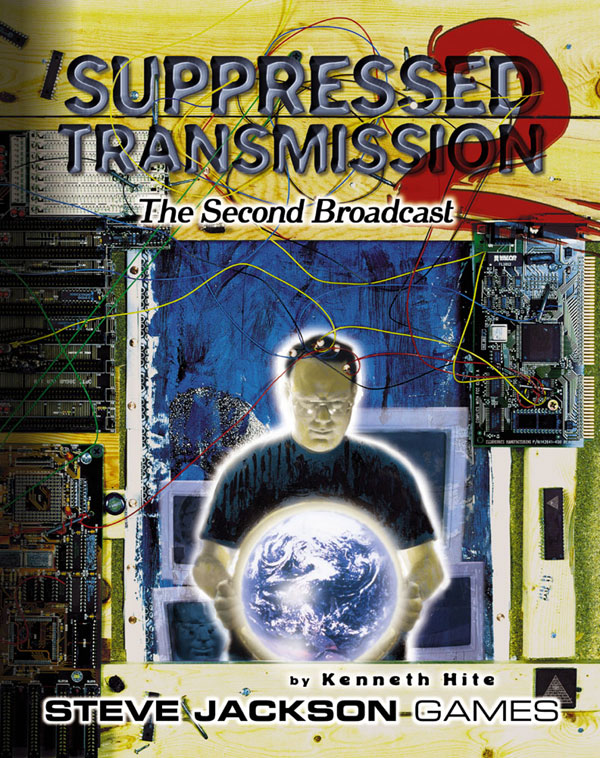
They are part of the Suppressed Transmissions.
Suppressed Transmission was a weekly column by Kenneth Hite that ran in the online version of Pyramid Magazine for 300 columns. It covered a range of topics that Hite described in the first column as conspiracy, horror, secret history, and alternate history. Covering a wide variety of topics he mixed references to legend or odd facts with gaming interpretations in most columns. While there were plenty of references to GURPS, given the source, there wasn't really any game specific materials. Some of his departures from the standard format were campaign reports on two different Unknown Armies campaigns, an annual analysis (in the aforementioned areas) of a Shakespeare play, and a couple of worked examples of applying the materials to a game.
While collecting weird has been something I've always done it was the Suppressed Transmissions that got me involving it in my gaming. At this point that usage has become a hallmark of my style. Much of the World After is directly influenced by material from columns and much of the rest is influenced by the style Ken Hite brought out in the columns.
Sadly, with the end of Pyramid Online access to the columns in no longer available. Those of us who still had subscriptions were able to download all the content although even then some Suppressed Transmissions are missing. Steve Jackson Games did produce two volumes collecting some columns. These volumes are excellent with extensive footnoting and cross referencing of the columns. Sadly, these volumes are still available in physical format. I say sadly because their poor sales have kept SJG from investing the time and effort needed to get more of the columns collected. There has been a Where I Read series of posts about them on RPG.net by someone who saved each column as it was written. One expressed purpose behind the series is to get the books sold out and the PDF version selling high enough to warrant more being done. Given the love of conspiracy porn these days I'm not sure a better effort isn't getting the books read outside of the gaming community.
Random half memories of my high school unified fantasy setting
If I'd written a heartbreaker this probably would have been the setting. The first version of it dates to 8-9th grade and the last probably to right after my senior year in HS. While technically almost all my campaigns (including a run at Rolemaster and T&T as well as D&D) used it I doubt 90% of what I wrote ever mattered in game, at least on the broad level.
Anyway, quickies of what I remember:
The world was created by two immortals who created gifts for each other: the earth by the female and the sun and moon by the male. They earth was a flat disc which they both placed inside a sphere with the sun and moon mounted opposite each each other to create the world.
The immortals then had children who were the eight gods. Their children each created their own people. The only names I remember are the Ilbani, children of Turm. Turm was an evil ice goddess modeled a bit on a smiliar character in the Greyfax Grimwald (and all the Circle of Light novels I believe...I only read the first one). The Ilbani were sorta evil elves of the ice lands whose biggest distinguishing feature was they were their own riding animals. While riders had more status than the ridden (being the main divisions of society) in some ways the king's ridden had more status than the lowest rider.
The other races were sea giants, humans, regular elves, dwarves, sea dwarves, and two I don't remember...I think bald, bronze land giants and halflings of some kind.
Over time the children fell to fighting dividing into two groups of four (gender balanced of course) of good and evil gods. Their parents were dismayed by this and left, sealing their children into the sphere of the world until they could behave.
This lead to the traditional series of ages. In the first age the good gods centered themselves in the center of the world around the One Tree (Donaldson with a touch of Tolkien, not Norse myth) and were overrun by evil which destroyed the tree. That war remade the world in terms of geography. Dragons were born of this war of the gods, the four primal dragons rising directly out of the earth itself in the far north, east, south, and west. They were huge beings whose rising left cayons still present at the end of my history.
The second age ended in another similar battle in a pseudo-England (many of my early games were in small islands north of a main continent...imaginative I'm not). What ended the age was the direct confrontation in battle between Turm and the god of the humans. While she appeared to strike him down as he dropped his guard he disappeared and she feld (only writing this do I realize, hello, Star Wars). Over time the story grew that he ascended beyond the world by giving up the battle. I had plans for something really significant philosophically in this but I can't remember most of it.
The third age is coming to an end at the go point of the setting. The gods have not walked the earth in 1000 years since the above battle but now Turm is raising an army in the north. Humans have split into two main faiths, one that still follows their original god (whose cleric still have power) and ascentionists who also have clerics with power.
Looking back I see Eddings, Glorantha, Tolkien, The First and Second Chronicles of Thomas Covenant, Star Wars, Taoism, and Christianity as the main driving ideas in all of it.
Anyway, quickies of what I remember:
The world was created by two immortals who created gifts for each other: the earth by the female and the sun and moon by the male. They earth was a flat disc which they both placed inside a sphere with the sun and moon mounted opposite each each other to create the world.
The immortals then had children who were the eight gods. Their children each created their own people. The only names I remember are the Ilbani, children of Turm. Turm was an evil ice goddess modeled a bit on a smiliar character in the Greyfax Grimwald (and all the Circle of Light novels I believe...I only read the first one). The Ilbani were sorta evil elves of the ice lands whose biggest distinguishing feature was they were their own riding animals. While riders had more status than the ridden (being the main divisions of society) in some ways the king's ridden had more status than the lowest rider.
The other races were sea giants, humans, regular elves, dwarves, sea dwarves, and two I don't remember...I think bald, bronze land giants and halflings of some kind.
Over time the children fell to fighting dividing into two groups of four (gender balanced of course) of good and evil gods. Their parents were dismayed by this and left, sealing their children into the sphere of the world until they could behave.
This lead to the traditional series of ages. In the first age the good gods centered themselves in the center of the world around the One Tree (Donaldson with a touch of Tolkien, not Norse myth) and were overrun by evil which destroyed the tree. That war remade the world in terms of geography. Dragons were born of this war of the gods, the four primal dragons rising directly out of the earth itself in the far north, east, south, and west. They were huge beings whose rising left cayons still present at the end of my history.
The second age ended in another similar battle in a pseudo-England (many of my early games were in small islands north of a main continent...imaginative I'm not). What ended the age was the direct confrontation in battle between Turm and the god of the humans. While she appeared to strike him down as he dropped his guard he disappeared and she feld (only writing this do I realize, hello, Star Wars). Over time the story grew that he ascended beyond the world by giving up the battle. I had plans for something really significant philosophically in this but I can't remember most of it.
The third age is coming to an end at the go point of the setting. The gods have not walked the earth in 1000 years since the above battle but now Turm is raising an army in the north. Humans have split into two main faiths, one that still follows their original god (whose cleric still have power) and ascentionists who also have clerics with power.
Looking back I see Eddings, Glorantha, Tolkien, The First and Second Chronicles of Thomas Covenant, Star Wars, Taoism, and Christianity as the main driving ideas in all of it.
L is for Legion of Superheroes (A-Z catch-up post)
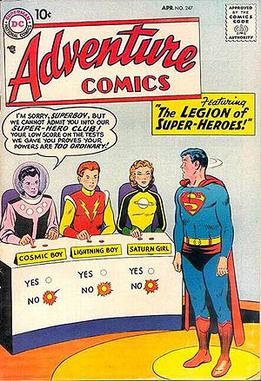
While The Knights of the Dinner Table are how I maintained contact with the broader gaming community while not gaming much it is not my one true love in comics. That honor is reserved for my first love in comics, The Legion of Superheroes. I still remember my first Legion comic. My grandfather bought me Superboy and the Legion of Superheroes Limited Collector's Edition in the summer of 1976 and I fell in love. The book as a large sized reprint format both big comic makers tested in the 70s.
 As noted above the book was reprints. The principle story was a reprint of Adventure comics #369-379 which were the first appearance of Mordru the Sorcerer, one of the greatest of villains the Legion would face. He was the creation of Jim Shooter who was about 15 at that time having written his first Legion story about a year earlier. His run is the Legion's first Golden Age and saw not only the introduction of Mordru but also the Fatal Five, my favorite super villain team of all time, and the death of Fero Lad, one of the few genuine deaths in superhero comics.
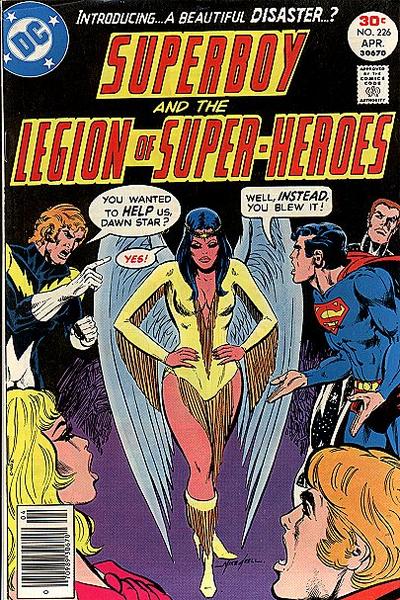
I would go on to semi-collect the comic for the rest of the 70s starting with issue #226 which introduced Dawnstar. I suspect the fact she was long my favorite Legionnaire and inspiration for my first RPG superhero (a heroine called The Nightingale who I created for Champions and played in Superworld). This was during the Legion's second golden age with Paul Levitz writing and Dave Cockrum (later famous for helping reboot the X-Men) and then Mike Grell drawing. Dave's classic costumes are still THE costumes for many of the Legionnaires in my mind, especially the side laced Princess Projectra and Phantom Girl costumes. I also followed the Karate Kid spin-off comic at that time.
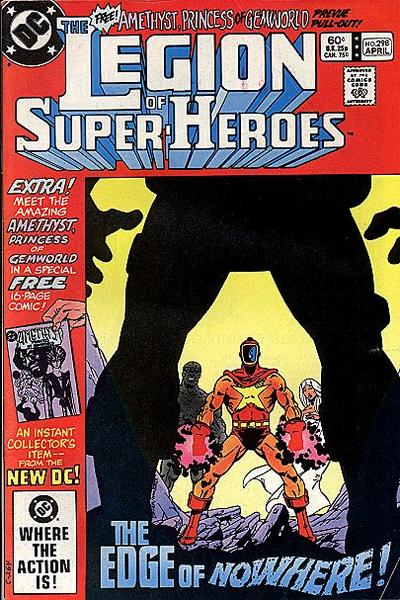
I would drift away for the book about 1980 until 1983 when spurred by the purchase of Champions I would ride my bike to every nearby convenience store to purchase comics. I just missed the classic Great Darkness Saga although I did get Annual #3 as it was released which included the story's epilogue. My actual return issue was #298 and I would be a regular reader until I joined the Navy.
I would be an irregular reader after that until about the same time I started up with KoDT. By this point the Legion was in its first reboot. While the rebooted Legion was interesting I enjoyed the Threeboot Legion that would begin in 2004. It's run, including the very enjoyable Supergirl and the Legion of Superheroes period would come to an end with the return of the DC Multiverse. Starting with the Lighting Saga that ran in both JSA (my other favorite DC super team which I followed during its 70s All Star run) and JLA, the original Legion is back in mainstream DC continuity although the other two teams remain official in alternate universe and even worked together in Final Crisis: Legion of 3 Worlds. The Legion returned with the return of Adventure comics and now once again have their own book. The run in Adventure now features the Legion Academy.
I've skipped a ton of stuff including the short lived Wanderers comic and the first reboot Legion becoming the New Wanderers, the time the Legion joined the annual JSA/JLA cross-over, the bouncing from Action to Adventure to Superboy to kicking Superboy out of his book to different series, and tons of other great material. With a history as long as the JLA and nearly as constant a presence there is a ton to mine. While as noted above Dawnstar would show up in my Champions learning experience and as a character in a Superworld game, although melded with Black Canary, I never ran a Legion game or, despite loving the Legion, the JSA, Infinity Inc., and the All Star Squadron owned the Mayfair DC RPG. I have tried to generate interest in a Legion oriented game or at least a Legion influenced game. My recent alternating Thursday campaign pitch is an example of the later. I'm not sure why I never got the MEGS DC Heroes back in the day. I had bought the earlier MSH (I had dutifully collected X-Men like all good early 80s geeks as well as Defenders which is the only Marvel team I ever really bought into until recently). I think it was a combination of the game coming out as I left high school, already owning several supers games (Champions, Superworld, MSH, V&V, and Superhero:2044). It wouldn't be until I started collect the reboot Legion that I got Blood of Heroes. I did eventually get both Legion books and the Time Trapper adventure series. If the M&M derived DC game comes out with Legion books I'm sure I'll get them (and wind up upgrading M&M).

I would go on to semi-collect the comic for the rest of the 70s starting with issue #226 which introduced Dawnstar. I suspect the fact she was long my favorite Legionnaire and inspiration for my first RPG superhero (a heroine called The Nightingale who I created for Champions and played in Superworld). This was during the Legion's second golden age with Paul Levitz writing and Dave Cockrum (later famous for helping reboot the X-Men) and then Mike Grell drawing. Dave's classic costumes are still THE costumes for many of the Legionnaires in my mind, especially the side laced Princess Projectra and Phantom Girl costumes. I also followed the Karate Kid spin-off comic at that time.
I would drift away for the book about 1980 until 1983 when spurred by the purchase of Champions I would ride my bike to every nearby convenience store to purchase comics. I just missed the classic Great Darkness Saga although I did get Annual #3 as it was released which included the story's epilogue. My actual return issue was #298 and I would be a regular reader until I joined the Navy.
I would be an irregular reader after that until about the same time I started up with KoDT. By this point the Legion was in its first reboot. While the rebooted Legion was interesting I enjoyed the Threeboot Legion that would begin in 2004. It's run, including the very enjoyable Supergirl and the Legion of Superheroes period would come to an end with the return of the DC Multiverse. Starting with the Lighting Saga that ran in both JSA (my other favorite DC super team which I followed during its 70s All Star run) and JLA, the original Legion is back in mainstream DC continuity although the other two teams remain official in alternate universe and even worked together in Final Crisis: Legion of 3 Worlds. The Legion returned with the return of Adventure comics and now once again have their own book. The run in Adventure now features the Legion Academy.
I've skipped a ton of stuff including the short lived Wanderers comic and the first reboot Legion becoming the New Wanderers, the time the Legion joined the annual JSA/JLA cross-over, the bouncing from Action to Adventure to Superboy to kicking Superboy out of his book to different series, and tons of other great material. With a history as long as the JLA and nearly as constant a presence there is a ton to mine.
Thursday, April 21, 2011
R is for Rifts
Okay, who didn't see this entry coming?
For the three of you out there who don't know what Rifts is the following is the description from the Palladium catalog: That really doesn't capture it. A better example is this ad from the Dragon twenty years ago when it was released. The ad also mentions the first three supplements Palladium produced for the game. The Sourcebook openly admits to being material cut from the core rules for space and it includes some excellent if whacked setting info (more about it below). The first two world books, Vampire Kingdoms and Atlantis, include some great ideas. Vampire Kingdoms features a central America ruled by vampires invulnerable to all human weapons but vulnerable to wooden stakes and running water. It was evocative enough that almost two decades later while reading the Dresden Files novel Changes I couldn't help but imagine the Red Court Vampires of Central and South America in Rifts via the same supplement. Atlantis includes magical tattoos and the inter-dimensional slavers the Splurgoth and their Blind Slave Women who were on the cover of Rifts first addition. Either of these books would be a great supplement for an old school science-fantasy campaign.
That is the power of Rifts. It is the Arduin of the 1990s combining classic fantasy tropes in a Gamma World setting being invaded by demons from hell whose depredations are opposed by mecha pilots. Every complaint about Palladium rules I mentioned in my Palladium post are present in spades. In fact, many of those complaints apply to Rifts exclusively or nearly exclusively.
Rifts also has an excellent off-shoot/subsetting: Phase World. This intergalatic campaign divided among three galaxies is perfect for Legion of Superheroes or other space supers campaigns or wild anime style space opera as well as classic Edward "World Wrecker" Hamilton and Doc E. E. Smith space opera. Among the great additions in Phase World are the Cosmic Knights which I've described as "The Green Lantern Corps with a Knights of the Round Table Questing Knight image instead of magic rings."
Still, I find myself buying Rifts books on the used market regularly. My anger over the company's internet policy has softened enough that the latest Phase World supplements I may buy outright. I started off this month with my RDR (Rifts Done Right) material and tomorrow will include a more mundane post in that series. Rifts is a constant source of discussion and dismay over on RPG.net, mainly a desire to find the right system to run it (hint, Palladium or some other classic D&D variant is a requirement IMHO).
For the old school Rifts, more than almost any other Palladium line except perhaps fantasy, is a set of overlooked classics. If you want gonzo, metal, comic book science fantasy you owe it to yourself to find a ley line and walk into the Earth of Rifts.
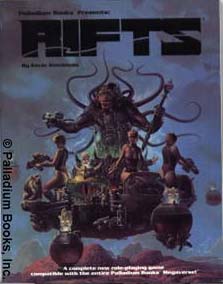
For the three of you out there who don't know what Rifts is the following is the description from the Palladium catalog:
Rifts® is a multi-genre role-playing game that captures the imagination unlike any other. Elements of magic, horror, and the supernatural co-exist with science, high technology and the ordinary. The game spans countless dimensions, making anything and everything possible. Players are truly limited only by their imaginations!

That is the power of Rifts. It is the Arduin of the 1990s combining classic fantasy tropes in a Gamma World setting being invaded by demons from hell whose depredations are opposed by mecha pilots. Every complaint about Palladium rules I mentioned in my Palladium post are present in spades. In fact, many of those complaints apply to Rifts exclusively or nearly exclusively.
Rifts also has an excellent off-shoot/subsetting: Phase World. This intergalatic campaign divided among three galaxies is perfect for Legion of Superheroes or other space supers campaigns or wild anime style space opera as well as classic Edward "World Wrecker" Hamilton and Doc E. E. Smith space opera. Among the great additions in Phase World are the Cosmic Knights which I've described as "The Green Lantern Corps with a Knights of the Round Table Questing Knight image instead of magic rings."
Still, I find myself buying Rifts books on the used market regularly. My anger over the company's internet policy has softened enough that the latest Phase World supplements I may buy outright. I started off this month with my RDR (Rifts Done Right) material and tomorrow will include a more mundane post in that series. Rifts is a constant source of discussion and dismay over on RPG.net, mainly a desire to find the right system to run it (hint, Palladium or some other classic D&D variant is a requirement IMHO).
For the old school Rifts, more than almost any other Palladium line except perhaps fantasy, is a set of overlooked classics. If you want gonzo, metal, comic book science fantasy you owe it to yourself to find a ley line and walk into the Earth of Rifts.
K is for Knights of the Dinner Table (A-Z catch-up post)

While I was married I did very little gaming and came close to losing all connection to the hobby. When my wife and I separated I started to regain my connection to gaming in general and, in many ways, the older side of the hobby through one principle mechanism, a comic book. That comic was The Knights of the Dinner Table (KODT for short).
The comic wasn't new to me. I had kept reading magazines during the 90s in between rare games. I even have several issues of Shadis prior to 10 including #2 with the first appearance of the Knights...well, of BA and Bob. It was hanging out at the Dragon's Lair in Hartford, Connecticut (or was it New Britain, they were close to the line) on a Friday night that I bought my first issue. I soon collected all the back issues I could and have been a regular reader ever since.
For those not familiar with the comic it's primary story concerns the exploits, mostly but not exclusively, at the game table of the titled group. The consistent members have BA, a long suffering DM; Bob, the archetypal power gamer compensating for lack of control in his real life; Dave, a specimen of that rare breed, the jock gamer (if only mild as a jock); Sarah, book club loving specimen of the women Vampire brought to the hobby; and Brian, rules lawyer and con man who you keep around because when the chips are down loyalty rules over everything else. The game they most commonly play is Hackmaster which became popular enough to become a game in it's own right. They have also played several other games from the same company including Hacknoia (X-Files), Cattlepunk (Western), Spacehack, Scream of Kachooloo, and Heroes and Zeros (supers). Two other groups have appeared more than one: The Black Hand Gaming Society and Patty's Perpetrators.
The world of KoDT is arguably an RPGer's dream, where large associations and conventions are common and the FLGS is still the meeting place and hang out. The stories often involve convoluted plots in the real world that are attempts to gain advantage or revenge in game. Those convoluted real world plots are one of the great aspects as you and buddies have tried those very plots in game multiple times.
In fact, the greatest strength of KoDT is it's realism. It's not realistic in the traditional sense of the plots mirror the real world. Instead, the character bring the realism. Each of the regulars including the Knights, Black Hands, and the preps are people we've with whom we've played games. My current group is a mix of the Knights and the Perps and I would jump at a chance to play with either group (although I'll admit I'd prefer the Perps).
It's that realism that reconnected me to gaming when I came back. It reminded me of where the real fun of gaming is. It's in sitting around a table with a bunch of people who if they aren't friends they will be after a few sessions. It's in the slightly off personalities we all bring to the table. It's the obsessions that come through in our characters.
KoDT is all of that writ larger than life.
Subscribe to:
Posts (Atom)