Showing posts with label A-Z Blogging Challenge. Show all posts
Showing posts with label A-Z Blogging Challenge. Show all posts
Monday, April 25, 2011
Throwing in the Towel...
I won't be finishing out A-Z. I'm out of steam and I think I'm better served by admitting defeat than phoning this week in.

Personal Appendix N: T is for Two to Conquer

Two to Conquer
 is another Darkover novel sharing a setting Hawkmistress, although considerably later time wise.
It has stronger science fantasy elements combined with a weird Prisoner of Zenda type plot. The book opens with Paul Harrell, a criminal sealed into a stasis coffin, being summoned out of it to Darkover. He is the unique duplicate of Bard di Asturien and has been summoned to provide his duplicate. Bard is one of two leaders struggling to unite the Hundred Kingdoms. The novel covers the beginning of their union under the Compact achieved not by Bard, who is the novel's principle character, but his rival Varzil the Good.
The book has several very game worthy ideas. The most interesting is the science behind not only the ability to summon Paul but why he had to exist: Cherilly's law. The law states "Nothing is unique in space and time except a matrix; every item in the universe exists with one and only one exact duplicate, except a matrix stone." A matrix stone is a stone native to Darkover (but also capable of being created) that amplifies psionic powers. Matrix stones and Cherilly's Law could be a magical idea that could propel an entire series of adventures or even be a cornerstone of a campaign. Imagine a megadungeon which made prominent use of this principle.
There are a couple of other ideas that jump out at me. Among things in the Compact is the outlawing of distance weapons requiring those who intend to kill to place themselves at risk. The other is the novel recounts the initial interactions between the the Priestesses of Avarra and the Sisterhood of the Sword mentioned in the Hawkmistress entry which leaders to the Order of Renunciations.
Friday, April 22, 2011
S is for Suppressed Transmission

Consider the following list:
- Hollow History
- Emperor Norton
- Airship sightings
- Spring Heeled Jack
- Le Comte de Saint-Germain
- Chess
- Conspiracy
- The Tempest
- Alternate Earths
- The King of Cats
- The Lamina
- Captain Heinlein of the US Spaceforces
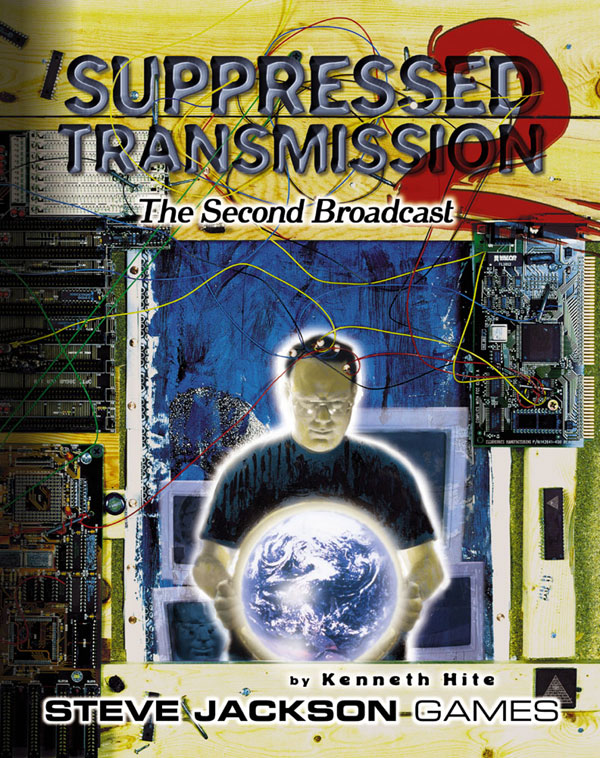
They are part of the Suppressed Transmissions.
Suppressed Transmission was a weekly column by Kenneth Hite that ran in the online version of Pyramid Magazine for 300 columns. It covered a range of topics that Hite described in the first column as conspiracy, horror, secret history, and alternate history. Covering a wide variety of topics he mixed references to legend or odd facts with gaming interpretations in most columns. While there were plenty of references to GURPS, given the source, there wasn't really any game specific materials. Some of his departures from the standard format were campaign reports on two different Unknown Armies campaigns, an annual analysis (in the aforementioned areas) of a Shakespeare play, and a couple of worked examples of applying the materials to a game.
While collecting weird has been something I've always done it was the Suppressed Transmissions that got me involving it in my gaming. At this point that usage has become a hallmark of my style. Much of the World After is directly influenced by material from columns and much of the rest is influenced by the style Ken Hite brought out in the columns.
Sadly, with the end of Pyramid Online access to the columns in no longer available. Those of us who still had subscriptions were able to download all the content although even then some Suppressed Transmissions are missing. Steve Jackson Games did produce two volumes collecting some columns. These volumes are excellent with extensive footnoting and cross referencing of the columns. Sadly, these volumes are still available in physical format. I say sadly because their poor sales have kept SJG from investing the time and effort needed to get more of the columns collected. There has been a Where I Read series of posts about them on RPG.net by someone who saved each column as it was written. One expressed purpose behind the series is to get the books sold out and the PDF version selling high enough to warrant more being done. Given the love of conspiracy porn these days I'm not sure a better effort isn't getting the books read outside of the gaming community.
L is for Legion of Superheroes (A-Z catch-up post)
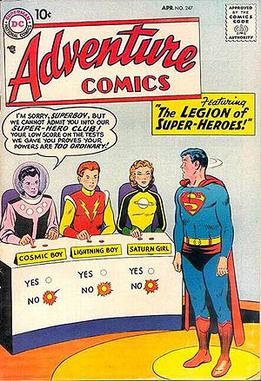
While The Knights of the Dinner Table are how I maintained contact with the broader gaming community while not gaming much it is not my one true love in comics. That honor is reserved for my first love in comics, The Legion of Superheroes. I still remember my first Legion comic. My grandfather bought me Superboy and the Legion of Superheroes Limited Collector's Edition in the summer of 1976 and I fell in love. The book as a large sized reprint format both big comic makers tested in the 70s.
 As noted above the book was reprints. The principle story was a reprint of Adventure comics #369-379 which were the first appearance of Mordru the Sorcerer, one of the greatest of villains the Legion would face. He was the creation of Jim Shooter who was about 15 at that time having written his first Legion story about a year earlier. His run is the Legion's first Golden Age and saw not only the introduction of Mordru but also the Fatal Five, my favorite super villain team of all time, and the death of Fero Lad, one of the few genuine deaths in superhero comics.
I would go on to semi-collect the comic for the rest of the 70s starting with issue #226 which introduced Dawnstar. I suspect the fact she was long my favorite Legionnaire and inspiration for my first RPG superhero (a heroine called The Nightingale who I created for Champions and played in Superworld). This was during the Legion's second golden age with Paul Levitz writing and Dave Cockrum (later famous for helping reboot the X-Men) and then Mike Grell drawing. Dave's classic costumes are still THE costumes for many of the Legionnaires in my mind, especially the side laced Princess Projectra and Phantom Girl costumes. I also followed the Karate Kid spin-off comic at that time.
I would drift away for the book about 1980 until 1983 when spurred by the purchase of Champions I would ride my bike to every nearby convenience store to purchase comics. I just missed the classic Great Darkness Saga although I did get Annual #3 as it was released which included the story's epilogue. My actual return issue was #298 and I would be a regular reader until I joined the Navy.
I would be an irregular reader after that until about the same time I started up with KoDT. By this point the Legion was in its first reboot. While the rebooted Legion was interesting I enjoyed the Threeboot Legion that would begin in 2004. It's run, including the very enjoyable Supergirl and the Legion of Superheroes period would come to an end with the return of the DC Multiverse. Starting with the Lighting Saga that ran in both JSA (my other favorite DC super team which I followed during its 70s All Star run) and JLA, the original Legion is back in mainstream DC continuity although the other two teams remain official in alternate universe and even worked together in Final Crisis: Legion of 3 Worlds. The Legion returned with the return of Adventure comics and now once again have their own book. The run in Adventure now features the Legion Academy.
I've skipped a ton of stuff including the short lived Wanderers comic and the first reboot Legion becoming the New Wanderers, the time the Legion joined the annual JSA/JLA cross-over, the bouncing from Action to Adventure to Superboy to kicking Superboy out of his book to different series, and tons of other great material. With a history as long as the JLA and nearly as constant a presence there is a ton to mine. While as noted above Dawnstar would show up in my Champions learning experience and as a character in a Superworld game, although melded with Black Canary, I never ran a Legion game or, despite loving the Legion, the JSA, Infinity Inc., and the All Star Squadron owned the Mayfair DC RPG. I have tried to generate interest in a Legion oriented game or at least a Legion influenced game. My recent alternating Thursday campaign pitch is an example of the later. I'm not sure why I never got the MEGS DC Heroes back in the day. I had bought the earlier MSH (I had dutifully collected X-Men like all good early 80s geeks as well as Defenders which is the only Marvel team I ever really bought into until recently). I think it was a combination of the game coming out as I left high school, already owning several supers games (Champions, Superworld, MSH, V&V, and Superhero:2044). It wouldn't be until I started collect the reboot Legion that I got Blood of Heroes. I did eventually get both Legion books and the Time Trapper adventure series. If the M&M derived DC game comes out with Legion books I'm sure I'll get them (and wind up upgrading M&M).

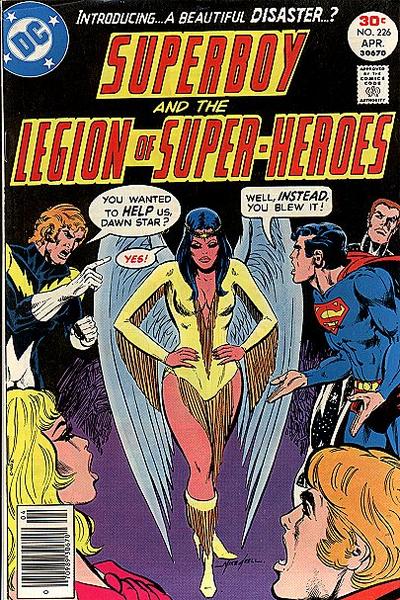
I would go on to semi-collect the comic for the rest of the 70s starting with issue #226 which introduced Dawnstar. I suspect the fact she was long my favorite Legionnaire and inspiration for my first RPG superhero (a heroine called The Nightingale who I created for Champions and played in Superworld). This was during the Legion's second golden age with Paul Levitz writing and Dave Cockrum (later famous for helping reboot the X-Men) and then Mike Grell drawing. Dave's classic costumes are still THE costumes for many of the Legionnaires in my mind, especially the side laced Princess Projectra and Phantom Girl costumes. I also followed the Karate Kid spin-off comic at that time.
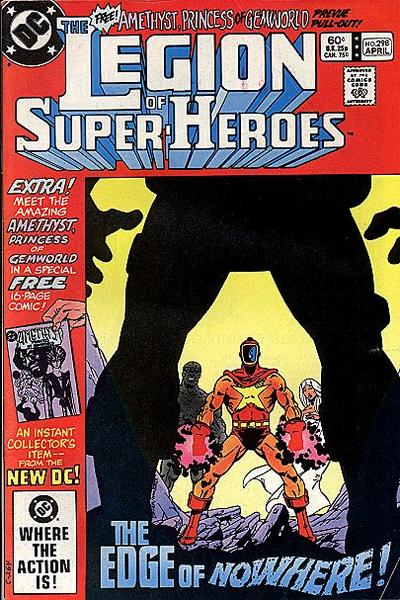
I would drift away for the book about 1980 until 1983 when spurred by the purchase of Champions I would ride my bike to every nearby convenience store to purchase comics. I just missed the classic Great Darkness Saga although I did get Annual #3 as it was released which included the story's epilogue. My actual return issue was #298 and I would be a regular reader until I joined the Navy.
I would be an irregular reader after that until about the same time I started up with KoDT. By this point the Legion was in its first reboot. While the rebooted Legion was interesting I enjoyed the Threeboot Legion that would begin in 2004. It's run, including the very enjoyable Supergirl and the Legion of Superheroes period would come to an end with the return of the DC Multiverse. Starting with the Lighting Saga that ran in both JSA (my other favorite DC super team which I followed during its 70s All Star run) and JLA, the original Legion is back in mainstream DC continuity although the other two teams remain official in alternate universe and even worked together in Final Crisis: Legion of 3 Worlds. The Legion returned with the return of Adventure comics and now once again have their own book. The run in Adventure now features the Legion Academy.
I've skipped a ton of stuff including the short lived Wanderers comic and the first reboot Legion becoming the New Wanderers, the time the Legion joined the annual JSA/JLA cross-over, the bouncing from Action to Adventure to Superboy to kicking Superboy out of his book to different series, and tons of other great material. With a history as long as the JLA and nearly as constant a presence there is a ton to mine.
Thursday, April 21, 2011
R is for Rifts
Okay, who didn't see this entry coming?
For the three of you out there who don't know what Rifts is the following is the description from the Palladium catalog: That really doesn't capture it. A better example is this ad from the Dragon twenty years ago when it was released. The ad also mentions the first three supplements Palladium produced for the game. The Sourcebook openly admits to being material cut from the core rules for space and it includes some excellent if whacked setting info (more about it below). The first two world books, Vampire Kingdoms and Atlantis, include some great ideas. Vampire Kingdoms features a central America ruled by vampires invulnerable to all human weapons but vulnerable to wooden stakes and running water. It was evocative enough that almost two decades later while reading the Dresden Files novel Changes I couldn't help but imagine the Red Court Vampires of Central and South America in Rifts via the same supplement. Atlantis includes magical tattoos and the inter-dimensional slavers the Splurgoth and their Blind Slave Women who were on the cover of Rifts first addition. Either of these books would be a great supplement for an old school science-fantasy campaign.
That is the power of Rifts. It is the Arduin of the 1990s combining classic fantasy tropes in a Gamma World setting being invaded by demons from hell whose depredations are opposed by mecha pilots. Every complaint about Palladium rules I mentioned in my Palladium post are present in spades. In fact, many of those complaints apply to Rifts exclusively or nearly exclusively.
Rifts also has an excellent off-shoot/subsetting: Phase World. This intergalatic campaign divided among three galaxies is perfect for Legion of Superheroes or other space supers campaigns or wild anime style space opera as well as classic Edward "World Wrecker" Hamilton and Doc E. E. Smith space opera. Among the great additions in Phase World are the Cosmic Knights which I've described as "The Green Lantern Corps with a Knights of the Round Table Questing Knight image instead of magic rings."
Still, I find myself buying Rifts books on the used market regularly. My anger over the company's internet policy has softened enough that the latest Phase World supplements I may buy outright. I started off this month with my RDR (Rifts Done Right) material and tomorrow will include a more mundane post in that series. Rifts is a constant source of discussion and dismay over on RPG.net, mainly a desire to find the right system to run it (hint, Palladium or some other classic D&D variant is a requirement IMHO).
For the old school Rifts, more than almost any other Palladium line except perhaps fantasy, is a set of overlooked classics. If you want gonzo, metal, comic book science fantasy you owe it to yourself to find a ley line and walk into the Earth of Rifts.
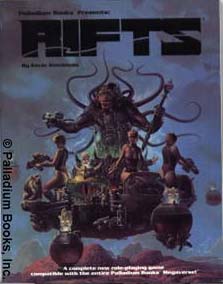
For the three of you out there who don't know what Rifts is the following is the description from the Palladium catalog:
Rifts® is a multi-genre role-playing game that captures the imagination unlike any other. Elements of magic, horror, and the supernatural co-exist with science, high technology and the ordinary. The game spans countless dimensions, making anything and everything possible. Players are truly limited only by their imaginations!

That is the power of Rifts. It is the Arduin of the 1990s combining classic fantasy tropes in a Gamma World setting being invaded by demons from hell whose depredations are opposed by mecha pilots. Every complaint about Palladium rules I mentioned in my Palladium post are present in spades. In fact, many of those complaints apply to Rifts exclusively or nearly exclusively.
Rifts also has an excellent off-shoot/subsetting: Phase World. This intergalatic campaign divided among three galaxies is perfect for Legion of Superheroes or other space supers campaigns or wild anime style space opera as well as classic Edward "World Wrecker" Hamilton and Doc E. E. Smith space opera. Among the great additions in Phase World are the Cosmic Knights which I've described as "The Green Lantern Corps with a Knights of the Round Table Questing Knight image instead of magic rings."
Still, I find myself buying Rifts books on the used market regularly. My anger over the company's internet policy has softened enough that the latest Phase World supplements I may buy outright. I started off this month with my RDR (Rifts Done Right) material and tomorrow will include a more mundane post in that series. Rifts is a constant source of discussion and dismay over on RPG.net, mainly a desire to find the right system to run it (hint, Palladium or some other classic D&D variant is a requirement IMHO).
For the old school Rifts, more than almost any other Palladium line except perhaps fantasy, is a set of overlooked classics. If you want gonzo, metal, comic book science fantasy you owe it to yourself to find a ley line and walk into the Earth of Rifts.
K is for Knights of the Dinner Table (A-Z catch-up post)

While I was married I did very little gaming and came close to losing all connection to the hobby. When my wife and I separated I started to regain my connection to gaming in general and, in many ways, the older side of the hobby through one principle mechanism, a comic book. That comic was The Knights of the Dinner Table (KODT for short).
The comic wasn't new to me. I had kept reading magazines during the 90s in between rare games. I even have several issues of Shadis prior to 10 including #2 with the first appearance of the Knights...well, of BA and Bob. It was hanging out at the Dragon's Lair in Hartford, Connecticut (or was it New Britain, they were close to the line) on a Friday night that I bought my first issue. I soon collected all the back issues I could and have been a regular reader ever since.
For those not familiar with the comic it's primary story concerns the exploits, mostly but not exclusively, at the game table of the titled group. The consistent members have BA, a long suffering DM; Bob, the archetypal power gamer compensating for lack of control in his real life; Dave, a specimen of that rare breed, the jock gamer (if only mild as a jock); Sarah, book club loving specimen of the women Vampire brought to the hobby; and Brian, rules lawyer and con man who you keep around because when the chips are down loyalty rules over everything else. The game they most commonly play is Hackmaster which became popular enough to become a game in it's own right. They have also played several other games from the same company including Hacknoia (X-Files), Cattlepunk (Western), Spacehack, Scream of Kachooloo, and Heroes and Zeros (supers). Two other groups have appeared more than one: The Black Hand Gaming Society and Patty's Perpetrators.
The world of KoDT is arguably an RPGer's dream, where large associations and conventions are common and the FLGS is still the meeting place and hang out. The stories often involve convoluted plots in the real world that are attempts to gain advantage or revenge in game. Those convoluted real world plots are one of the great aspects as you and buddies have tried those very plots in game multiple times.
In fact, the greatest strength of KoDT is it's realism. It's not realistic in the traditional sense of the plots mirror the real world. Instead, the character bring the realism. Each of the regulars including the Knights, Black Hands, and the preps are people we've with whom we've played games. My current group is a mix of the Knights and the Perps and I would jump at a chance to play with either group (although I'll admit I'd prefer the Perps).
It's that realism that reconnected me to gaming when I came back. It reminded me of where the real fun of gaming is. It's in sitting around a table with a bunch of people who if they aren't friends they will be after a few sessions. It's in the slightly off personalities we all bring to the table. It's the obsessions that come through in our characters.
KoDT is all of that writ larger than life.
Wednesday, April 20, 2011
Q is for Quest of the Ancients
Which has been covered by at least two others.
Tim's comments in my heartbreakers post got me to order it. I had hoped it would be here in time to make it this post, but no such luck.
Tim's comments in my heartbreakers post got me to order it. I had hoped it would be here in time to make it this post, but no such luck.
Memoir is Story...
I got to thinking about story in RPGs after reading the Hack & Slash analysis of O Glossary entries at the Forge. Specifically, of interest is the idea of "Ouija Board Roleplaying". The idea evolves out of the belief at the Forge that one must prioritize and create story intentionally for it to occur in roleplaying. Edwards et al would go on to claim that players in Simulationist play (defined by them as play that prioritizing exploration), especially those who who concentrate on exploring a world as is the case in most OSR influenced games were expecting story to simply emerge which, according to them, was impossible.
While the analysis does skewer the issue appropriately I think it misses something crucial. It's conclusion gives a key to this:
What is confused here is that story, or better yet narrative, is not restricted to fiction. In fiction, narrative is a planned thing. The author chooses which events occur in the fictional universe. If the author chooses it to happen it happens and until he inserts it into the story it hasn't even happened. We may presume Harry Dresden eats every night at Burger King but until Jim Butcher inserts a visit to BK by Harry it hasn't happened. Remember our ability to insert such events because they create an interesting symmetry later.
In contrast, a memoir constructs a narrative out of a set of pre-existing events. A person takes everything they've experienced in their life and selects a series of events that tells the story of their life. Biography does the same thing but the process is done by someone else. Journalism and history can also be done this way. Shelby Foote's history of the Civil War is not groundbreaking in the sense that Foote perused primary sources to create a unique history of the war. Foote worked strictly from secondary sources but created a narrative version of the war. Foote's success is not in finding new facts but creating a coherent story that organized facts about the war.
That is what Edward's misses in what he calls simulationist play. Players in these games are living parts of the life of their characters. Story emerges not because the people at the table are co-authors creating a story in the fictional sense. Instead, they are individuals who, after the fact, create memoirs of their characters' lives. This is how story "magically" emerges during play. People look at the events they experience, decide which are important, and arrange them into a story. In the broader sense the game can be seen as creating history which I think is what -C is after when he talks about things like motivations for NPCs and external events. However, in saying we're not waiting for interesting events I think -C goes a few degrees off target. As he points out we create interesting interactions but we only know which ones are memorable and important (those part of the story) after the fact.
I think the problem many people have with this concept of story emerging from play is its lack of uniqueness. If we view the emerging story from play as memoir constructed by each player then Osric the Fighter will tell a different story that Mallamabar the Druid and both will be different from the story of Ian Lee the Monk. This maps very well to my experience. Ask all your players to summarize what happened last session separately and you will get roughly the same story but some will include parts omitted in others and the emphasis of common parts will be different. If your goal is literary story via play you won't get the Lord of the Rings. You will, however, get the first three volumes of Durrell's Alexandria Quartet.
Note: When I first posted this I forgot about the interesting symmetry I pointed out in the fiction example: We call also take fiction and back fill the other details. This is what much of fandom is about, filling in the non-story details that interest us or move the story closer to the one we want told.
While the analysis does skewer the issue appropriately I think it misses something crucial. It's conclusion gives a key to this:
The entire category is a strawman, because there is not a single actual real world instantiation of his example. People aren't sitting around tables, and rolling them, waiting for an interesting occurrence, they are playing a game, and characters, and it's those interactions that create something special.I would argue in sandbox and other OSR playstyles we are in fact waiting for interesting occurrences. In fact waiting for interesting occurrences as opposed to having them fixed in place as much happen items is one of the defining characteristics of sandboxes and other open play forms (another mistake I think he makes but that's a quibble, a sandbox is always open play but not vice versa).
What is confused here is that story, or better yet narrative, is not restricted to fiction. In fiction, narrative is a planned thing. The author chooses which events occur in the fictional universe. If the author chooses it to happen it happens and until he inserts it into the story it hasn't even happened. We may presume Harry Dresden eats every night at Burger King but until Jim Butcher inserts a visit to BK by Harry it hasn't happened. Remember our ability to insert such events because they create an interesting symmetry later.
In contrast, a memoir constructs a narrative out of a set of pre-existing events. A person takes everything they've experienced in their life and selects a series of events that tells the story of their life. Biography does the same thing but the process is done by someone else. Journalism and history can also be done this way. Shelby Foote's history of the Civil War is not groundbreaking in the sense that Foote perused primary sources to create a unique history of the war. Foote worked strictly from secondary sources but created a narrative version of the war. Foote's success is not in finding new facts but creating a coherent story that organized facts about the war.
That is what Edward's misses in what he calls simulationist play. Players in these games are living parts of the life of their characters. Story emerges not because the people at the table are co-authors creating a story in the fictional sense. Instead, they are individuals who, after the fact, create memoirs of their characters' lives. This is how story "magically" emerges during play. People look at the events they experience, decide which are important, and arrange them into a story. In the broader sense the game can be seen as creating history which I think is what -C is after when he talks about things like motivations for NPCs and external events. However, in saying we're not waiting for interesting events I think -C goes a few degrees off target. As he points out we create interesting interactions but we only know which ones are memorable and important (those part of the story) after the fact.
I think the problem many people have with this concept of story emerging from play is its lack of uniqueness. If we view the emerging story from play as memoir constructed by each player then Osric the Fighter will tell a different story that Mallamabar the Druid and both will be different from the story of Ian Lee the Monk. This maps very well to my experience. Ask all your players to summarize what happened last session separately and you will get roughly the same story but some will include parts omitted in others and the emphasis of common parts will be different. If your goal is literary story via play you won't get the Lord of the Rings. You will, however, get the first three volumes of Durrell's Alexandria Quartet.
Note: When I first posted this I forgot about the interesting symmetry I pointed out in the fiction example: We call also take fiction and back fill the other details. This is what much of fandom is about, filling in the non-story details that interest us or move the story closer to the one we want told.
Wednesday, April 13, 2011
Silver Age Appendix N: I is for (The) Iron Lords
One key difference between Appendix N in the DMG and the Suggested Reading in Moldvay Basic is the inclusion of a number of contemporary books. Among them are The Iron Lords
 by Andrew Offutt. It is the first of a trilogy of novels although only the first two are listed by Moldvay, I believe because the text was prepared before the last book was released.
The Iron Lords begins the story of Jarrik the Blacksword. It begins when Jarrik is eight and his village is destroyed by Viking like raiders leaving only him and his sister alive. Setting out in a rowboat to gain he revenge (he heard the name of the attacker's commander) he and his sister are picked up by another longship of the same people. Jarrik lives among them as an outcast but grows to manhood. One thing that is continually noted is Jarrik's fair hair is more like that of his adopted people and the people who killed his family.
Jarrik, however, is not able to fit in and over time moves to another village before being taken by three of the Gods on Earth, the Iron Lords, and enlisted in their war against The Lady of the Snowmist, patron deity of those who slay his family.
Along the way Jarrik has visions and displays a non-warrior side. Both his visions and much of the Gods on Earth display scientific elements giving a small science fantasy air to the novels. While from the late 70s it is clear the books are in the same vein, if not quite the same quality, of much of the material in the original Appendix N.
Tuesday, April 12, 2011
J is for Jorune
If you hang around older roleplayers you hear about three truly great and classic settings: Glorantha of Runequest and Heroquest as well as several board games; Tekumel of Empire of the Petal Throne, miniatures rules and a couple other sets of miniature rules; and Jorune.
I first heard of Skyrealms of Jorune from ads in Dragon Magazine. It was the product of an English class assignment and an early Metamorphosis Alpha campaign. I never had the first edition but apparently it was much more gonzo than the later editions. Given the nature of the world in the second and third, which I do own, more gonzo is saying something.
The world of Jorune was originally a colony planet of humanity. A preserve for humanity had been negotiated with the native race, the Shanthas. When news of a apocalyptic war on Earth reached the colony humans burst out of their preserves in a grab for more space. In response the seemingly primitive Shanthas destroyed the entire colony. Humanity was so scattered that one human geneticist uplifted several Earth animals to preserve the races of earth.
Now, several hundred years later humanity, diverted into several species including one that can use isho the native energy of Jorune, and about a dozen other intelligent species, both from Earth and elsewhere, compete for the planet. Starting characters are Tauther, potential citizens of the major human kingdom. Tauther become citizens by having citizens inscribe Earth metal tablets with their endorsement. This provides a great framework for a very old school picaresque campaign.
The second edition was a boxed set. Initially it had a custom system that was much revised in an insert to a Runequest like system. Isho wielding provides magic while lost Earth Tec from the early colony period provides super science. The result is a unique science-fantasy setting that seems parts Gamma World, Tekumel, and standard D&D. A few supplements were produced. Two covered regions of Jorune. The rarest, Earth Tec Jorune, would be a great addition to science fantasy campaigns such as The Metal Earth or Planet Algol. About this time there was also a DOS game, Alien Logic.
A later, third edition, was from Chessex and was poorly received due to editing errors. This is sad given it was a labor of love from a member of the Jorune community. Sadly, Jorune never seemed to develop the community that Glorantha and Tekumel have. There is an excellent website with lots of additional material and conversations to about every game under the sun but that seems to be about it. The core properties seem to be lost to the dustbin of unsupported games.
One last note to the Jorune. The Skyrealms of the title were free floating islands created when crystaline magma cooled in pockets near the surface. The same energy field that created isho powers also caused the crystal to levitate breaking off a floating island. The second edition boxed set has an adventure set in (and named after) The SkyRealm Kolovisondra. Finding the explanation with diagrams for a skyrealm could be a great addition to many games.
I first heard of Skyrealms of Jorune from ads in Dragon Magazine. It was the product of an English class assignment and an early Metamorphosis Alpha campaign. I never had the first edition but apparently it was much more gonzo than the later editions. Given the nature of the world in the second and third, which I do own, more gonzo is saying something.
The world of Jorune was originally a colony planet of humanity. A preserve for humanity had been negotiated with the native race, the Shanthas. When news of a apocalyptic war on Earth reached the colony humans burst out of their preserves in a grab for more space. In response the seemingly primitive Shanthas destroyed the entire colony. Humanity was so scattered that one human geneticist uplifted several Earth animals to preserve the races of earth.
Now, several hundred years later humanity, diverted into several species including one that can use isho the native energy of Jorune, and about a dozen other intelligent species, both from Earth and elsewhere, compete for the planet. Starting characters are Tauther, potential citizens of the major human kingdom. Tauther become citizens by having citizens inscribe Earth metal tablets with their endorsement. This provides a great framework for a very old school picaresque campaign.
The second edition was a boxed set. Initially it had a custom system that was much revised in an insert to a Runequest like system. Isho wielding provides magic while lost Earth Tec from the early colony period provides super science. The result is a unique science-fantasy setting that seems parts Gamma World, Tekumel, and standard D&D. A few supplements were produced. Two covered regions of Jorune. The rarest, Earth Tec Jorune, would be a great addition to science fantasy campaigns such as The Metal Earth or Planet Algol. About this time there was also a DOS game, Alien Logic.
A later, third edition, was from Chessex and was poorly received due to editing errors. This is sad given it was a labor of love from a member of the Jorune community. Sadly, Jorune never seemed to develop the community that Glorantha and Tekumel have. There is an excellent website with lots of additional material and conversations to about every game under the sun but that seems to be about it. The core properties seem to be lost to the dustbin of unsupported games.
One last note to the Jorune. The Skyrealms of the title were free floating islands created when crystaline magma cooled in pockets near the surface. The same energy field that created isho powers also caused the crystal to levitate breaking off a floating island. The second edition boxed set has an adventure set in (and named after) The SkyRealm Kolovisondra. Finding the explanation with diagrams for a skyrealm could be a great addition to many games.
Monday, April 11, 2011
I is for ION Guard
ION Guard is a supplement for both ICONS and BASH detailing an intergalactic group of peace keepers and policemen who gain power from super science glove. This glove, powered by a central battery created by an ancient race at the center of the universe, can be used only by the purest and bravest among sentients.
Yeah, it's what you think.
I bought the ICONS version and nearly bought the BASH version. I'm glad 15 chapters plus an additional chapter of sketches. Topics cover the history, organization, and selection of the guards. Overall they provide a workable Green Lantern Corps type organization for your supers game to play on the interstellar/intergalactic scale. It also provides individual villians as well as a group. One of the villains is an evil god and his followers in a working Darkseid clone.
Character creation is where both the strength and weakness of this background shows. The normal random character creation of ICONS (I purchased the ICON version) is substituted by straight info for the first four of seven character creation steps. The result is a campaign of ION Guards will have very similar characters. This is a plus in creating a comic but not great for an RPG group. Although the rules detail a few adventure seeds what they don't discuss is integrating an ION Guard in a larger space campaign nor the details of such a campaign.
What it does tell us is Radioactive Ape Designs has an upcoming supplement called Alien Empires. The ad has the ION Guard symbol as the background implying it is in the same universe. I'm looking forward to this supplement because it is a prominent area of comics not well covered in RPGs.
In retrospect I've not disappointed I only bought the ICONS version. While the material is good it is too narrow for easy usage. I would recommend fans of either system purchase it if they are interested in a Green Lantern type organization. If you are more interested in general space faring supers I'd hold off for Alien Empires.
Yeah, it's what you think.
I bought the ICONS version and nearly bought the BASH version. I'm glad 15 chapters plus an additional chapter of sketches. Topics cover the history, organization, and selection of the guards. Overall they provide a workable Green Lantern Corps type organization for your supers game to play on the interstellar/intergalactic scale. It also provides individual villians as well as a group. One of the villains is an evil god and his followers in a working Darkseid clone.
Character creation is where both the strength and weakness of this background shows. The normal random character creation of ICONS (I purchased the ICON version) is substituted by straight info for the first four of seven character creation steps. The result is a campaign of ION Guards will have very similar characters. This is a plus in creating a comic but not great for an RPG group. Although the rules detail a few adventure seeds what they don't discuss is integrating an ION Guard in a larger space campaign nor the details of such a campaign.
What it does tell us is Radioactive Ape Designs has an upcoming supplement called Alien Empires. The ad has the ION Guard symbol as the background implying it is in the same universe. I'm looking forward to this supplement because it is a prominent area of comics not well covered in RPGs.
In retrospect I've not disappointed I only bought the ICONS version. While the material is good it is too narrow for easy usage. I would recommend fans of either system purchase it if they are interested in a Green Lantern type organization. If you are more interested in general space faring supers I'd hold off for Alien Empires.
Saturday, April 9, 2011
Silver Age Appendix N: H is for Hawkmistress!

In the late 70s and early 80s when I started to play D&D my reading ran to female authorized science fantasy such as Pern, Witchworld, and Darkover. The Darkover novel Hawkmistress!
 is second only to Dragonsong
 /Dragonsinger
 as favorites in this period.
Like most of these novels Hawkmistress! is a coming of age story. Romilly is the tomboyish daughter of minor noble. More interested and proficient with bow, hounds, and hawking than embroidery she feels an arranged marriage. Along the way she discovers her inherent laran (psionic) powers, joins an order of female mercenaries, befriends a king, and saves a kingdom.
For a gamer it is probably not the best Darkover novel. I drew more from The Shattered Chain
 and Two to Conquer
 . There are a few interesting ideas, such as women mercenaries, the Sisterhood of the Sword (a group that was one of the two ancestors of Order of Renunciates in later novels), and nuclear contamination from psionic weapons. It also lead to my interest in falconry as a sport, although I've never been in a position to gain my license or train a bird.
Most of the Darkover novels are now out of print or in omnibus editions (as the links above show). That said, I've had little problem finding them used, including wonderful DAW yellow spines.
Friday, April 8, 2011
G is for GURPS
The very first rpg I waited for to come out was GURPS.
In the late 70s about the same time I was introduced to D&D I was introduced to Microgames by Metagaming. Two of them were great little combat games that shared the same basic system: Melee and Wizard. They only required six sided dice, were moderately crunchy, and easy to play. As D&D started to take over the gaming scene Metagaming presented three expansions: Advanced Melee, Advanced Wizard, and In the Labyrinth which turned the two games into The Fantasy Trip, a full blown RPG (actually they'd long been named The Fantasy Trip: Melee and The Fantasy Trip: Wizard).
Why am I discussing out of print and forgotten RPGs in this post?
Because these "roll 3d6 under your attribute" games were designed by none other than Steve Jackson. In fact, when he left Metagaming to form Steve Jackson Games he tried to buy the games to print himself. When that didn't pan out he began work on their successor. Because instead of just a fantasy game he wanted to write a generic system that could be used for all systems. He wanted a universal game. Generic Universal Roleplaying System became the joke working title for his new game.
Then, in 1985 GURPS: Melee came out. Okay so it was really called Man to Man: Fantasy Combat From GURPS but it was similar in concept. Over the next few years GURPS would go through its first two editions until the grand Third Edition came out in 1989.
From the Second Edition on I have owned a copy. I have a nearly complete GURPS Third Edition including even rare books like all four WoD licensed books and Witch World. For the 90s GURPS would be my go to system and I even own the Fourth Edition Core. These days it's not on the front burner but I'd play it.
I often have considered running "The GURPS Trip", a simplified GURPS than hearkened back to The Fantasy Trip. The biggest change would be all skills would be bought at stat level so you wouldn't need to keep complex point counts or separate scores for each. Advanced combat would be used for the mapping but little else. I would have a much smaller list of ads/disads and those with levels would be fixed at specific ones.
Regardless of whether or not I play GURPS itself again the five or so feet of GURPS 3rd edition sourcebooks will remain. Even Classic D&D games have seen me use them. In fact, the biggest achievement of GURPS was probably the source books which were always designed to be of maximal utility in any game system. In fact, that was part of SJG sale strategy.
If you are willing to experiment with crunch even now I'd recommend taking GURPS for a whirl. You can download free light rules for 3rd and 4th editions. Give it a try.
In the late 70s about the same time I was introduced to D&D I was introduced to Microgames by Metagaming. Two of them were great little combat games that shared the same basic system: Melee and Wizard. They only required six sided dice, were moderately crunchy, and easy to play. As D&D started to take over the gaming scene Metagaming presented three expansions: Advanced Melee, Advanced Wizard, and In the Labyrinth which turned the two games into The Fantasy Trip, a full blown RPG (actually they'd long been named The Fantasy Trip: Melee and The Fantasy Trip: Wizard).
Why am I discussing out of print and forgotten RPGs in this post?
Because these "roll 3d6 under your attribute" games were designed by none other than Steve Jackson. In fact, when he left Metagaming to form Steve Jackson Games he tried to buy the games to print himself. When that didn't pan out he began work on their successor. Because instead of just a fantasy game he wanted to write a generic system that could be used for all systems. He wanted a universal game. Generic Universal Roleplaying System became the joke working title for his new game.
Then, in 1985 GURPS: Melee came out. Okay so it was really called Man to Man: Fantasy Combat From GURPS but it was similar in concept. Over the next few years GURPS would go through its first two editions until the grand Third Edition came out in 1989.
From the Second Edition on I have owned a copy. I have a nearly complete GURPS Third Edition including even rare books like all four WoD licensed books and Witch World. For the 90s GURPS would be my go to system and I even own the Fourth Edition Core. These days it's not on the front burner but I'd play it.
I often have considered running "The GURPS Trip", a simplified GURPS than hearkened back to The Fantasy Trip. The biggest change would be all skills would be bought at stat level so you wouldn't need to keep complex point counts or separate scores for each. Advanced combat would be used for the mapping but little else. I would have a much smaller list of ads/disads and those with levels would be fixed at specific ones.
Regardless of whether or not I play GURPS itself again the five or so feet of GURPS 3rd edition sourcebooks will remain. Even Classic D&D games have seen me use them. In fact, the biggest achievement of GURPS was probably the source books which were always designed to be of maximal utility in any game system. In fact, that was part of SJG sale strategy.
If you are willing to experiment with crunch even now I'd recommend taking GURPS for a whirl. You can download free light rules for 3rd and 4th editions. Give it a try.
Thursday, April 7, 2011
F is for Forge Out of Chaos, Fifth Cycle, and Fantasy Heartbreakers
One of the seminal articles of the indie rpg movement is Ron Edward's Fantasy Heartbreakers. He described a very specific type of fantasy RPG. They were games designed by people whose primary, possibly only, RPG experience. They reproduced the kind of movements away from D&D made in the late 70s/early 80s by games like Runequest and Rolemaster. However, they were trying to replicate the success of these games 15 to 20 years later.
The various retro-clones are not heartbreakers. First, few if any of them are designed without knowledge of the larger RPG scene. More importantly they are not attempts to replicate the commercial success of TSR. In fact, the retroclone movement is much closer to the indie RPG scene Edwards champions. The commercial naivety of the heartbreakers was one of Edwards' primary source of heartbreak. That said, I believe those of us in the OSR can learn a lot from the heartbreakers and, long before I heard of the OSR (before it existed actually) I set out to answer the call at the conclusion of the article:
I collected all I could. I would develop three favorites, the two Edwards found interesting and Fifth Cycle which I'd actually almost purchased when it first came out.
Forge Out of Chaos is the most enthusiastic RPG I've ever read. Imagine the energy of James Raggi IV infused into a March Madness fanatic who instead of basketball was into RPGs. While many games have made me want to play them this is the only one which I wanted to play with the creators.
Fifth Cycle has a quirkiness to the world that I liked. Dwarves and elves, for example, instead of being ancient races that pre-date men are one of many races created by sorcerer kings during the Third Cycle. The just begun Fifth Cycle is recapturing magic after anti-magic dark ages of the Fourth. For some reason I can't put my finger on the whole thing struck me as what Glorantha would be had Greg Stafford played D&D and read fantasy before he created it instead of being a mythology junkie.
One would think D20 and later the OSR would have ended the Fantasy Heartbreaker. After all, now you can put out your setting and rules in a variety of formats that don't require purchasers to adopt an entirely new framework. Yet, sites like Drivethru RPG are full of heartbreakers.
And I want to tell you the same thing nearly a decade later. Find one, on eBay or Drivethru, and take a month off your regular game. You might find you don't go back.
The various retro-clones are not heartbreakers. First, few if any of them are designed without knowledge of the larger RPG scene. More importantly they are not attempts to replicate the commercial success of TSR. In fact, the retroclone movement is much closer to the indie RPG scene Edwards champions. The commercial naivety of the heartbreakers was one of Edwards' primary source of heartbreak. That said, I believe those of us in the OSR can learn a lot from the heartbreakers and, long before I heard of the OSR (before it existed actually) I set out to answer the call at the conclusion of the article:
Let's play them. My personal picks are Dawnfire and Forge: Out of Chaos, but yours might be different. I say, grab a Heartbreaker and play it, and write about it. Find the nuggets, practice some comparative criticism, think historically.
Get your heart broken with me.
I collected all I could. I would develop three favorites, the two Edwards found interesting and Fifth Cycle which I'd actually almost purchased when it first came out.
Forge Out of Chaos is the most enthusiastic RPG I've ever read. Imagine the energy of James Raggi IV infused into a March Madness fanatic who instead of basketball was into RPGs. While many games have made me want to play them this is the only one which I wanted to play with the creators.
Fifth Cycle has a quirkiness to the world that I liked. Dwarves and elves, for example, instead of being ancient races that pre-date men are one of many races created by sorcerer kings during the Third Cycle. The just begun Fifth Cycle is recapturing magic after anti-magic dark ages of the Fourth. For some reason I can't put my finger on the whole thing struck me as what Glorantha would be had Greg Stafford played D&D and read fantasy before he created it instead of being a mythology junkie.
One would think D20 and later the OSR would have ended the Fantasy Heartbreaker. After all, now you can put out your setting and rules in a variety of formats that don't require purchasers to adopt an entirely new framework. Yet, sites like Drivethru RPG are full of heartbreakers.
And I want to tell you the same thing nearly a decade later. Find one, on eBay or Drivethru, and take a month off your regular game. You might find you don't go back.
Wednesday, April 6, 2011
E is for EMaN: Extended Mobility and Neutralization Robot
Prior to the war three series of EMan Armor were produced by the US Army: Teutonic, Hospitaller, and Templar. All followed the same basic pattern. The Teutonic is described below then modifications as needed for the Hospitaller and Templar. A fourth, more powerful type, called the Dragon was designed but only rumors of its appearance are know.
Hand to Hand Damage: All variants do 1d6 Superhuman damage in melee combat.
Sensors:The armor has two sensors: night vision (the same effect as a dark vision spell) and heat vision (the same effect as a detect invisible spell). A successful sensor role can provide the benefits of night vision (use the chart for the spell for range using the skill roll) or heat vision (range as per spell using character level). Rolls need to made once a turn or, for invisible, when new invisible items appear. The sensors are two systems in terms of damage.
Radio: The unit has a two way military radio system with a range of about 5km. However, it is designed to provide a radio cloud so that units chain and extend their range. This feature is very rarely used in the post-Night world as very few units are available.
Reloading:The railgun takes a full turn to reload. The pilot can load single rounds then fire at a rate of one shot every other round in extreme need.
Ammo Weight: Each round weighs 1#. See APEMan Class effects of using improvised ammo. Improvised ammo has the same weight.
Cargo Capacity: 300#
Move: 15" (150 feet) plus the ability to leap up to 10 feet vertically for each 2" (20 ft) of horizontal movement sacrificed.
Non-APEMaN Pilot Usage: Modern Soldiers trained in Armor Pilot may use the EMaN armor but with half their attack bonus (round down) and attacks (round up). Persons not trained in armor piloting may not use power armor but may hide inside it.
Repair: As a product of pre-Night technology the cost of materials is twice that for contemporary vehicles and equipment. In most locations it is also half as common. The suits may be repaired with contemporary materials with normal costs and rarity. However, for every two hit points repaired in this manner one is removed from the maximum hit points of the armor with a minimum maximum hit points equal to half stated above.
Start-up and Shut-down: One of the downsides of the unit is it's start-up and shut-down time. Each take a full turn (10 minutes). A pilot may attempt to speed either up by rolling his pilot skill. A successful skill roll lowers the time by one round (1 minute) for the roll value with a minimum of 1 minute shutdown. On failed start-up add one minute to the start-up time although the pilot can try again with a +1 for each penalty minute accrued. A failed shut-down immediately shuts down the unit but adds a five minute penalty to the next start-up including the +5 penalty to a hurried start-up roll.
| Version | AC | Hit Points | Railgun Range | Railgun Damage | Railgun Magazine Capacity |
|---|---|---|---|---|---|
| Teutonic | 4[15] | 28 | 4100 ft. | 2d6 Superhuman | 25 rounds |
| Hospitaler | 3[16] | 32 | 4100 ft. | 2d6 Superhuman | 30 rounds |
| Templar | 2[17] | 36 | 4500 ft. | 2d6 Superhuman | 25 rounds |
Hand to Hand Damage: All variants do 1d6 Superhuman damage in melee combat.
Sensors:The armor has two sensors: night vision (the same effect as a dark vision spell) and heat vision (the same effect as a detect invisible spell). A successful sensor role can provide the benefits of night vision (use the chart for the spell for range using the skill roll) or heat vision (range as per spell using character level). Rolls need to made once a turn or, for invisible, when new invisible items appear. The sensors are two systems in terms of damage.
Radio: The unit has a two way military radio system with a range of about 5km. However, it is designed to provide a radio cloud so that units chain and extend their range. This feature is very rarely used in the post-Night world as very few units are available.
Reloading:The railgun takes a full turn to reload. The pilot can load single rounds then fire at a rate of one shot every other round in extreme need.
Ammo Weight: Each round weighs 1#. See APEMan Class effects of using improvised ammo. Improvised ammo has the same weight.
Cargo Capacity: 300#
Move: 15" (150 feet) plus the ability to leap up to 10 feet vertically for each 2" (20 ft) of horizontal movement sacrificed.
Non-APEMaN Pilot Usage: Modern Soldiers trained in Armor Pilot may use the EMaN armor but with half their attack bonus (round down) and attacks (round up). Persons not trained in armor piloting may not use power armor but may hide inside it.
Repair: As a product of pre-Night technology the cost of materials is twice that for contemporary vehicles and equipment. In most locations it is also half as common. The suits may be repaired with contemporary materials with normal costs and rarity. However, for every two hit points repaired in this manner one is removed from the maximum hit points of the armor with a minimum maximum hit points equal to half stated above.
Start-up and Shut-down: One of the downsides of the unit is it's start-up and shut-down time. Each take a full turn (10 minutes). A pilot may attempt to speed either up by rolling his pilot skill. A successful skill roll lowers the time by one round (1 minute) for the roll value with a minimum of 1 minute shutdown. On failed start-up add one minute to the start-up time although the pilot can try again with a +1 for each penalty minute accrued. A failed shut-down immediately shuts down the unit but adds a five minute penalty to the next start-up including the +5 penalty to a hurried start-up roll.
Tuesday, April 5, 2011
D is for Damage
The single biggest complaint about Rifts is MDC. Originally introduced in Robotech to give different scales for mecha from humans it actually worked fairly well. One MDC=100 SDC (hit points). More importantly, while it scales down (1 MDC to an SDC structure/person is recorded as 100 SDC) it doesn't scale up (doing 100 SDC to an MDC creature does nothing).
However, when transplanted to Rifts and applied to creatures as well as objects it started to break down. Specifically, if MDC weapons are in use and you don't have MDC armor you are 1 hit (maybe 2 if you don't have excess blow through armor) from death. There are MDC hand guns in Rifts while some tanks have SDC guns so an infantry man in MDC armor with one of this pistols can walk up to a talk and waste it without risk.
The general solution is to reduce MDC:SDC ratios (20:1 and 10:1 are popular) and allow SDC to do divide by ratio and round down MDC damage. A much better solution, in my view, was presented by Jim Stoner a decade ago. My S&W RDR system draws heavily on it.
The key idea is hit points/armor and damage ratings have both a number (25 hp, d6 damage) and a scale (normal, superhuman, supernatural). When the scale of the target and the attack are the same it's just a normal game. It is important to remember armor can upgrade your defenses. If you have modern armor treat your defenses as superhuman when figuring effects of hits for example. When they are different the following chart gives the changes to the effect.
Critical Hits:A roll of a natural 20 is a possible critical hit. Roll the attack again and if it hits treat it as one scale higher. This is an open ended roll up to a Critical Supernatural hit which does double the supernatural damage.
If an attack is insured at least a glance a roll of 1 will do no damage regardless of damage class difference.
What does what class of damage and provides what class of effect?
Hand to hand attacks by normal humans and similar monsters plus most pre-modern weapons do normal damage. Armor from the same period provides normal defense. Most creatures and structures have normal hit points.
Modern weapons (post 1920ish) do superhuman and modern armor is superhuman in defense. Modern harden structures and armored equipment have superhuman hit points. Some medium level magic and supernatural creatures (troll, ogres, giants) might do superhuman damage and have superhuman hit points.
Highly magical creatures such as dragons and demons, very powerful magic spells, and Clarke's Third Law level technology do supernatural damage. The creatures and equipment at this level have supernatural defenses.
Note on Magic Weapons/Armor:My general rule for magic weapons/armor will be they do the class they are in unless otherwise noted. There is no reason a sword +1 or plate +1 can't be rated superhuman. My one exception would be shields. I would not let shields alone upgrade defenses.
However, when transplanted to Rifts and applied to creatures as well as objects it started to break down. Specifically, if MDC weapons are in use and you don't have MDC armor you are 1 hit (maybe 2 if you don't have excess blow through armor) from death. There are MDC hand guns in Rifts while some tanks have SDC guns so an infantry man in MDC armor with one of this pistols can walk up to a talk and waste it without risk.
The general solution is to reduce MDC:SDC ratios (20:1 and 10:1 are popular) and allow SDC to do divide by ratio and round down MDC damage. A much better solution, in my view, was presented by Jim Stoner a decade ago. My S&W RDR system draws heavily on it.
The key idea is hit points/armor and damage ratings have both a number (25 hp, d6 damage) and a scale (normal, superhuman, supernatural). When the scale of the target and the attack are the same it's just a normal game. It is important to remember armor can upgrade your defenses. If you have modern armor treat your defenses as superhuman when figuring effects of hits for example. When they are different the following chart gives the changes to the effect.
| Attack Type | Defense Type | |||
|---|---|---|---|---|
| Normal | Superhuman | Supernatural | ||
| Normal | Glancing | No Damage | No Damage | No Damage |
| Hit | Full Damage | Half Damage (round down) | Quarter Damage (round down) | |
| Superhuman | Glancing | Half Damage | No Damage | No Damage |
| Hit | Double Damage | Full Damage | Half Damage (round down) | |
| Supernatural | Glancing | Full Damage | Half Damage (round down) | No Damage |
| Hit | Quadrupled Damage | Double Damage | Full Damage | |
Critical Hits:A roll of a natural 20 is a possible critical hit. Roll the attack again and if it hits treat it as one scale higher. This is an open ended roll up to a Critical Supernatural hit which does double the supernatural damage.
If an attack is insured at least a glance a roll of 1 will do no damage regardless of damage class difference.
What does what class of damage and provides what class of effect?
Hand to hand attacks by normal humans and similar monsters plus most pre-modern weapons do normal damage. Armor from the same period provides normal defense. Most creatures and structures have normal hit points.
Modern weapons (post 1920ish) do superhuman and modern armor is superhuman in defense. Modern harden structures and armored equipment have superhuman hit points. Some medium level magic and supernatural creatures (troll, ogres, giants) might do superhuman damage and have superhuman hit points.
Highly magical creatures such as dragons and demons, very powerful magic spells, and Clarke's Third Law level technology do supernatural damage. The creatures and equipment at this level have supernatural defenses.
Note on Magic Weapons/Armor:My general rule for magic weapons/armor will be they do the class they are in unless otherwise noted. There is no reason a sword +1 or plate +1 can't be rated superhuman. My one exception would be shields. I would not let shields alone upgrade defenses.
Monday, April 4, 2011
C is for Cyborg
The Cyborg is type of fighter. He has decided to trade parts of his body for mechanical replacements. This make him tougher and faster but at the cost of connection to the natural world. This both makes him less able to use magic and less able to heal from damage versus being repaired.
For all rules effects except as noted below treat him as a fighter per the S&W Whitebox rules or whatever baseline rules set you are using.
Hit points: The biggest complexity of the cyborg is he has both normal hit points (based on his biological being) and superhuman hit points (for his cyborg parts). These need to be tracked separately.
Normal hit points are gained as per the S&W rules. See the chart below, however, for modifiers to the roll at each level.
Superhuman hit points start at zero and are gained once at character creation based on which body parts are replaced. Superhuman hit points take damage first but cannot be healed naturally or magically (exception: some technomancer repair spells) but must actually be repaired. If there is spillover damage after superhuman hit points are all lost they spill over to regular hit points and any multiplier is applied to those points before damage is taken.
Hit dice penalty applies at all hit dice rolls after first level. It cannot result in negative hit points but can result in zero being gained. In fact, taking any combo that leads to -6 or more will mean the character is at max hit points ever at first level.
If all available replacement parts are taken (full cyborg) the character no longer needs to eat but will lose 1 superhuman hit point per week without regular preventive maintenance (not field maintenance).
Additional sense abilities for a cyborg head should be a permanent version of a sense enhancing spell. More powerful spells (such as detect invisible) should require a sensors skill roll.
Skills:Field mechanic and survival at 1. In addition, starting at level 2 the gain one skill point per even level. Characters with a cyborg head may spend points on sensors skill.
For all rules effects except as noted below treat him as a fighter per the S&W Whitebox rules or whatever baseline rules set you are using.
Hit points: The biggest complexity of the cyborg is he has both normal hit points (based on his biological being) and superhuman hit points (for his cyborg parts). These need to be tracked separately.
Normal hit points are gained as per the S&W rules. See the chart below, however, for modifiers to the roll at each level.
Superhuman hit points start at zero and are gained once at character creation based on which body parts are replaced. Superhuman hit points take damage first but cannot be healed naturally or magically (exception: some technomancer repair spells) but must actually be repaired. If there is spillover damage after superhuman hit points are all lost they spill over to regular hit points and any multiplier is applied to those points before damage is taken.
Replacement Parts:
The player must choose at character generation which body parts have been replaced.| Body Part | Armor Class Improvement | Supernatural Hit Points | Hit Dice Penalty | Other Advantages |
|---|---|---|---|---|
| Off Arm | -1[+1] | +2 | -1 | Hand to hand damage becomes superhuman +1 penalty to fine motor skill activities |
| Favored Arm | -1[+1] | +2 | -1 | Melee weapon damage becomes superhuman +1 penalty to fine motor skill activities; loses half of all bonuses from magic weapons. |
| Legs | -2[+2] | +6 | -2 | Double all movement rates |
| Torso | -2[+2] | +6 | -2 | +2 to all saving throws against physical damage/attacks; loses ability use magical potions |
| Head | -2[+2] | +6 | -2 | +2 to all saving throws against magical damage/attacks; gain dark vision initially and one sense addition every odd level up to (and including) level 9; loses ability to use magical scrolls and any magic item with an activation word; |
Hit dice penalty applies at all hit dice rolls after first level. It cannot result in negative hit points but can result in zero being gained. In fact, taking any combo that leads to -6 or more will mean the character is at max hit points ever at first level.
If all available replacement parts are taken (full cyborg) the character no longer needs to eat but will lose 1 superhuman hit point per week without regular preventive maintenance (not field maintenance).
Additional sense abilities for a cyborg head should be a permanent version of a sense enhancing spell. More powerful spells (such as detect invisible) should require a sensors skill roll.
Skills:Field mechanic and survival at 1. In addition, starting at level 2 the gain one skill point per even level. Characters with a cyborg head may spend points on sensors skill.
C is For Combat
An outline of the changes and additions to S&W combat for the high powered future of RDR.
You can find the complaints all over the net so I'll concentrate on why I consider it a strength. As has been hashed over forever combat in classic D&D, and thus in the clones, is highly abstract. It isn't designed to treat combat blow by blow but to get combat over quickly so the main thrust, exploration, can continue. As such, keeping that same abstract style in a game about exploring and being the white hatted sheriff in a post-magical holocaust world makes sense. The changes and additions should be only those needed to represent the broader scale of damage capability offered by high tech and, to a lesser degree, a higher magical baseline. It is to these ends I present these additions.
My additions and changes come in two big sections. Today we're going to cover additions to include new weapons types, long ranges, and the idea of hitting versus penetrating. Tomorrow, under D is for Damage we'll cover my damage scaling system.
Using Power Armor: Users get as many attacks and bonus as they normally have if APEMaN class. Modern Soldiers trained in Armor Pilot may use the EMaN armor but with half their attack bonus (round down) and attacks (round up). Persons not trained in armor piloting may not use power armor. They may, however, use the armor for protection but won't be able to engage in combat.
Benefits of Being in Power Armor: Damage is initially applied to the armor/vehicle with the user taking 1 HP normal for every 5 full points of damage on hits (but not glances) to the armor. This damage to occupants is not susceptible to scale difference multipliers. When the armor is reduced to zero HP it is non-functional although it still provides it's AC to the user if he stays in it. Power armor at zero or less hit points cannot move or attack, but can communicate, use sensors, ect unless otherwise damaged. Single section vehicles function essentially the same.
Vehicles: Vehicles have one or more sections. Multi-section vehicles will have individual hit points and defined functions for each section as well as a hit location chart. When a section is reduced to zero those functions are not available.
Accessory Damage: On a glancing shot vehicles and power armor may suffer accessory damage. Determine how much the shot missed by subtracting the roll from the hit number. The roll on the power armor accessory damage chart below for power armor or single section vehicles or the vehicle hit location chart and subtract the missed amount. The hit accessory or the first listed working function for the section is damaged and out of combat. If a system is not present or already damaged the result is a "no damage" result.
Basic Philosophy
One of the key ideas of Palladium's Megaversal System is the idea that the basic processes are the same regardless of genre. Thus, at its core, Rifts uses the same combat system as all Palladium games. This, in fact, is very true. Rifts combat (in the core at least) is closer to combat in The Mechanoids Invasion than combat in D&D3 is to OD&D. This is both a source of many complaints about Rifts and, IMHO, a strength.You can find the complaints all over the net so I'll concentrate on why I consider it a strength. As has been hashed over forever combat in classic D&D, and thus in the clones, is highly abstract. It isn't designed to treat combat blow by blow but to get combat over quickly so the main thrust, exploration, can continue. As such, keeping that same abstract style in a game about exploring and being the white hatted sheriff in a post-magical holocaust world makes sense. The changes and additions should be only those needed to represent the broader scale of damage capability offered by high tech and, to a lesser degree, a higher magical baseline. It is to these ends I present these additions.
My additions and changes come in two big sections. Today we're going to cover additions to include new weapons types, long ranges, and the idea of hitting versus penetrating. Tomorrow, under D is for Damage we'll cover my damage scaling system.
Additions and Changes
Hits and Glances: The single biggest addition is the idea of a glance. A hit is defined as normal in S&W. A glance is any attack which fails to hit a target but would hit AC 9[10]. The idea is that on a glance the attacker delivered one or more blows/shots that landed on the target but did not penetrate its armor. Glances have two principle uses. When dealing with attacks whose scale is higher than the armor it is attacking (see D for Damage for explanations of scale). Second, glances may provide partial damage to vehicles and power armor. If all damage being used is the same scale and no vehicles/power armor is in use don't worry about glances.Using Power Armor: Users get as many attacks and bonus as they normally have if APEMaN class. Modern Soldiers trained in Armor Pilot may use the EMaN armor but with half their attack bonus (round down) and attacks (round up). Persons not trained in armor piloting may not use power armor. They may, however, use the armor for protection but won't be able to engage in combat.
Benefits of Being in Power Armor: Damage is initially applied to the armor/vehicle with the user taking 1 HP normal for every 5 full points of damage on hits (but not glances) to the armor. This damage to occupants is not susceptible to scale difference multipliers. When the armor is reduced to zero HP it is non-functional although it still provides it's AC to the user if he stays in it. Power armor at zero or less hit points cannot move or attack, but can communicate, use sensors, ect unless otherwise damaged. Single section vehicles function essentially the same.
Vehicles: Vehicles have one or more sections. Multi-section vehicles will have individual hit points and defined functions for each section as well as a hit location chart. When a section is reduced to zero those functions are not available.
Accessory Damage: On a glancing shot vehicles and power armor may suffer accessory damage. Determine how much the shot missed by subtracting the roll from the hit number. The roll on the power armor accessory damage chart below for power armor or single section vehicles or the vehicle hit location chart and subtract the missed amount. The hit accessory or the first listed working function for the section is damaged and out of combat. If a system is not present or already damaged the result is a "no damage" result.
| Roll (d20) | Hit Accessory |
|---|---|
| 10 or lower | Nothing Damaged |
| 11-12 | Communication |
| 13-14 | Sensors |
| 15-16 | Secondary Weapon (first listed undamaged if more than one) |
| 17-18 | Life Support |
| 19 | Primary Weapon |
Saturday, April 2, 2011
Silver Age Appendix N: B is for The Book of Three/The Black Cauldron

 and The Black Cauldron. The books, fitting true D&D tradition, are part of a coming of age series whose primary character is the newly appointed Assistant Pig Keeper Taran. At the beginning of The Book of Three Taran is a young man tired of his duties as a farm hand caring the oracular pig Hen Wen. When Hen Wen flees as the evil Horned King, a servant of the Dark Lord Arwan, is seeking her Taran takes off to find her. His adventures bring him various companions including the semi-bestial Gurgi and the Taran's hero, Prince Gwydion. After capture by Queen Achren and the undead Cauldron Born they are imprisoned in Spiral Castle. Aided by her "niece", the Princess Eilonwy, Taran escapes with yet another individual the king turned wandering bard Fflewddur Fflam (who Eilonwy mistook for Gwydion). The three head to warn the High King in Caer Dathyl with the Horned King in purpose. In the process of the resulting adventures Taran determines that caring for Hen Wen isn't quite as bad as it seemed or adventure as fun as he thought.

The books are aimed at young adults. In fact, The Black Cauldron is a Newbury Honor Book and the final book of the series, The High King, was a Newbury Award Winner. Disney would make an animated movie called The Black Cauldron based on the first two books.
The books draw heavily on Welsh mythology. Alexander was researching Wales for a different book and saved the research for this series instead. I would recommend these books, as well as Castle of Lyr mentioned by Moldvay and Taran Wanderer and The High King which he didn't, for anyone interested in flavor for a Celtic campaign that eschew's the New Agey Celts of modern fantasy novels. They are quick reads and engaging even for adults.
In terms of gamable material they are rich. Eilonwy's bobble, the sword Taran wields at the end of the first book, and the Black Cauldron itself are interesting ideas for unique magic items. The Cauldron Born are interesting takes on zombies both in their capabilities and creation. Another set of Arwan's servants, the Huntsman, who gain strength as their fellows die were a standard in my early 80s campaigns. I was apparently not alone as a version appeared in the Dragon's Bestiary in Dragon issue 40. Fflewddur Fflam's only rival for my model of a bard back then was the Harper Menolly from the Pern series.
I know they had a huge influence on my Silver Age gaming. I think a similar influence on modern games of OD&D could be a good thing.
Friday, April 1, 2011
A is for APEMaN
The pride of the US Army in the period right before The Night of Blood and Tears was the Extended Mobility and Neutralization piloted robot. Designed for long term survivability they were the first successful attempt at larger than human sized fighting armor. While very few were deployed prior to the war they were very effective against demons, dragons, and inter-dimensional beings. As society collapsed one or more pilots were able to build fiefs by protecting the local populace with the suits as the stiffener to local militia.
While not hugely common between their strong survivability and the occasional unit found now and then in military caches they are still seen. Most suits are family heirlooms and most of those are held by de facto or outright noble families ruling over a small barony or county across the country side. Many adventurers fantasize about finding a suit and becoming a baron in their own right. While they are able to stand up to an individual dragon or demon, massed contemporary combat equipment, such as deployed by Superior and the other Lake States, can defeat an individual unit or even a small squad despite the individual superiority of the EMaN robot.
As Superior drives to expand they are pushing many barons out of their fiefs and the few that survive with their armor intact, or more often their children after a coup, have taken to the wilds as mercenaries and adventurers look for revenge or a new home.
Weapon and Armor Restrictions:APEMaN are trained in warfare and, as such,
have no restrictions on the kind of weapons or armor they can use.
Saving Throw:APEMaN receive a +2 bonus on saving throws vs. death and
poison (if using the alternative “Saving Throw Matrix” save as a fighter).
Experience Bonus for Dexterity: The APEMaN's prime attribute is Dexterity and he thus gets a 5% XP bonus for a Dexterity of 15+.
Initial Skills: Armor Pilot and Field Mechanic at 2. Survival all at 1.
In addition, starting at level 2 the APEMaN gains one skill point per level.
APEMaN characters also start out with 3d10 rounds of rail gun ammo. The rail guns can be armed with improvised ammo but with two effects. First, improvised ammo does 1d6 Extraordinary Damage, not Superhuman. Second, on a roll or 1 on any attack roll with improvised ammo the rail gun will jam. Clearing it in combat is hard task and fumbling it makes it impossible to clear in combat. Clearing can be done automatically in 1d8 hours outside of combat.
Given PC APEMaN are wanderers despite their equipment they tend to have little money. They start with 2d4x10 gold pieces or Superior Dollars (their choice).
Notes:
All RDR material is seriously alpha at this point. My first play test game will be the first Saturday in May.
Licensing
While not hugely common between their strong survivability and the occasional unit found now and then in military caches they are still seen. Most suits are family heirlooms and most of those are held by de facto or outright noble families ruling over a small barony or county across the country side. Many adventurers fantasize about finding a suit and becoming a baron in their own right. While they are able to stand up to an individual dragon or demon, massed contemporary combat equipment, such as deployed by Superior and the other Lake States, can defeat an individual unit or even a small squad despite the individual superiority of the EMaN robot.
As Superior drives to expand they are pushing many barons out of their fiefs and the few that survive with their armor intact, or more often their children after a coup, have taken to the wilds as mercenaries and adventurers look for revenge or a new home.
Creating a APEMaN (Armor Pilot, Extended Mobility and Neutralization)
Requirements and abilities
Dexterity Requirement: 10+Weapon and Armor Restrictions:APEMaN are trained in warfare and, as such,
have no restrictions on the kind of weapons or armor they can use.
Saving Throw:APEMaN receive a +2 bonus on saving throws vs. death and
poison (if using the alternative “Saving Throw Matrix” save as a fighter).
Experience Bonus for Dexterity: The APEMaN's prime attribute is Dexterity and he thus gets a 5% XP bonus for a Dexterity of 15+.
Initial Skills: Armor Pilot and Field Mechanic at 2. Survival all at 1.
Level Advancement
Use the experience point totals, hit points, to-hit, and saving throws from the S&W Whitebox Edition.In addition, starting at level 2 the APEMaN gains one skill point per level.
Starting Equipment
| Armor Selection 2d20 | |
|---|---|
| 2-4 | No armor |
| 5-10 | Fully Functional Teutonic Armor |
| 11-15 | Hospitaller Armor with max half-hitpoints |
| 16-17 | Fully Functional Hospitaller Armor |
| 18-19 | Templar Armor with max half-hitpoints |
| 20 | Fully Functional Templar Armor |
APEMaN characters also start out with 3d10 rounds of rail gun ammo. The rail guns can be armed with improvised ammo but with two effects. First, improvised ammo does 1d6 Extraordinary Damage, not Superhuman. Second, on a roll or 1 on any attack roll with improvised ammo the rail gun will jam. Clearing it in combat is hard task and fumbling it makes it impossible to clear in combat. Clearing can be done automatically in 1d8 hours outside of combat.
Given PC APEMaN are wanderers despite their equipment they tend to have little money. They start with 2d4x10 gold pieces or Superior Dollars (their choice).
Notes:
- The EMaN Robot will be described on Wednesday, April 6 as the E entry in the challenge.
- The hit point and damage types will be described on Tuesday, April 5 as the D (damage) entry in the challenge.
- Skills are chance the chance in 12 on a d12, the same as finding secret doors in the S&W rules.
All RDR material is seriously alpha at this point. My first play test game will be the first Saturday in May.
Licensing
Subscribe to:
Posts (Atom)