Thursday, December 10, 2009

Review: First Edition Feats/1E Heroic Abilities

In the rush of new products some older products that are clearly OSR material but "predate" the movement have gotten lost in the shuffle. Today we'll look at two of the from the same publisher and author: First Edition Feats and 1E Heroic Abilitiesby Malcolm Shepard at Mob United Media. Both supplements are PDFs available at RPGNow.com for $2.99 and $1.50 respectively.


First Edition Feats is an eleven page PDF two of which are taken up by a full color cover and the OGL. The contents are just what you would expect. It adds a feat system, except it calls its feats combat proficiencies, to 1st Edition AD&D and OSRIC. It should be easily adaptable to other versions of D&D with no or little work. The biggest issue for D&D as opposed to AD&D is it is based on the weapons proficiency system. Adopting it to the BECMI/RC weapons mastery system would be easy and either of those could be grafted onto the rest of the family.


The rules on combat proficiencies take about two pages of rules including design notes. It allows a character to substitute one of the combat proficiencies for a weapon proficiency. Each combat proficiency can be taken twice for two levels of effect. The rules require a character to take at least one weapon proficiency and prohibit the doubling of a combat proficiency at level one. The system recommends that monsters of at least low intelligence have access to the system at up to one combat proficiency per 2HD and requiring at least average intelligence to take a double proficiency. I can imagine an orge or orc shaman with a couple of these spicing up a combat.


The rest of material describes twenty-one combat proficiencies. Each has a name, one sentence description, prerequisite, class, single proficiency benefit, and double proficiency benefit. The prerequisites are generally ability score values or weapon proficiencies although there is one alignment prerequisite. Most of the abilities provide a small bonus under certain circumstances. For example, the Two Handed Weapon proficiency adds +1 to damage when using a two handed weapon. Shield Bash allows you to sacrifice you shield's AC bonus and use your shield as an off hand weapon. The only magic-user allowed proficiency allows magic-users to use a single type of magical weapon where the weapon type is not normally allowed but unable to use the magical abilities unless they take the double proficiency.


The proficiencies occasionally have two additional entries. Special gives notes outside of the above. For example the special section on the Archery proficiency notes you can use more than one slot on the double bonus, which is bow type specific, to use it with another bow type. The second section is called Normal. This to me is what makes this a true old school product. A common complaint against feats and skills in the OSR is they are limiting. If your character lacks feat X then they can't try to do that. While a valid complaint I think this is only half the story. As I've written before old school characters are made out of what they're good at doing. By supplying a normal rule for proficiencies which don't have rules already in place this supplement emphasizes the fact they are about what you're good at doing and not "permission" to do something.


While I have some quibbles, such as not opening up the special staff abilities to magic-users, in general I think this was worth the cost. I bought it for a proposed 2nd edition game and would probably use it with everything from that to Labrynth Lord. It is low impact in terms of time added to character creation and game play. It helps provide mechanical differentiation to the one class in older versions of D&D that really needs it, fighters. In fact, if you're in an older game with a dozen different fighter types you might be able to prune it some if you'd like. Finally, it provides a good outline to Dungeon Masters and players wanting to add their own unique abilities. If the publisher were to revisit it the one thing I'd like to see is a single page summary chart of the combat proficiencies.


I'm not as enthused about 1E Heroic Abilities. It is a mere six pages, again two used by the full color cover and OGL, and provides three related expansions to ability scores. First, for each class it defines certain abilities as having secondary ability scores. These are decimal scores identical to and generated in the same manner as exceptional strength. Roll percentiles for three ability scores for your class and list them in the traditional format: XX/yy. Once per day per level a character may roll percentiles against a given scores secondary ability and success allows you to treat it as the next highest value. You cannot use this to raise hit points or gain bonus spells.

The second usage is when the character has a base 18 in their prime requisite. For those characters it provides tables for 18/xx bonuses for the three ability scores which are prime requisites and don't 18/xx bonuses in the core rules. Dexterity adds to thief skills. Intelligence add languages and increases the chance to know spells and save versus illusions. Wisdom provides spells, additional magical attack saves, and magic resistance.

The final usage is to increase ability scores. At each level a character gets three dices pools of 3d10, 2d10, and 1d10 to add to there secondary ability scores. One must be assigned to each of the abilities for the class. If the total exceeds 100 you subtract 100 from the secondary abilities and increase the primary score by one.


This system isn't that different from those common in 'zines back in the day or even that in Hackmaster 4th edition. It's not as unique or compelling as First Edition Feats. I wouldn't recommend it as a separate purchase although if the two products were folded together and the price set at about four dollars I would recommend the combined product.

Wednesday, December 2, 2009

Inspirational Art: Ursula Verno


I found Ursula Verno when search for artistic inspiration for my Fantasy Nouveau idea. While art nouveau elves and dragons are quite common (the former having helped me find an earlier inspirational art entry) Ms. Verno did something I found interesting: art nouveau orc women. While intriquing they weren't quite what I was looking for. However, the page had a url for site. Searching the character galleries I found today's entry for inspirational art. Her notes on the piece indicate I would love to sell prints, but somehow I lost the original file, and the jpg is all that currently remains. Too bad, as I think they'd sell.

Still, we have this great image. I see the last druid of a culture whose waste of the land has left it a desert. She sits as a guardian of a tomb not of some great leader but of her culture's heritage and the consuming soul that destroyed it.

Monday, November 30, 2009

RPG Legos

A common concept of the OSR is the idea of making the game your own. Beyond keeping the rules available in print the strongest reason for the retro-clones is making the game your own. Mutant Future and Ruins & Ronin are among the best examples of this idea, neither being 100% compatible with a prior game even fairly tight clones like Labrynth Lord or Swords & Wizardry put their own spin on the past. Even more important are the numerous mini-supplements, add-ons, and fanzines like Advanced Edition Characters or Fight On!. They embody something common in the early days of RPGs explemlified by early fanzines, The Dragon (especially in the single and double digit issues) and other professional magazines, and the early fantasy games that were essentially house ruled D&D. These new products all aspire to regain the days when "playing D&D" meant you were playing a game whose genesis was in one or more of a series of books plublished by TSR, that you had a character who had a class and improved by going up in levels, and you had combat by rolling a d20. Beyond those basics you needed to learn the lay of the land, including rules and conventions as well as the setting, when setting down with a new group.


Regaining those days is a noble goal. The increased reliance in the hobby on official and "complete" rules and settings has diminished the hobby as a creative outlet. That said, some more modern games, viewed correctly, provide more of that vibe than we in the OSR acknowledge. In particular there are two systems readily available (one in print and one out of print but very, very common) that provide what I'll call RPG legos. There is so much published material for these systems, much of it contridictory and some of it trash, that a GM can easily mix and match his way to a unique game completely distinct from the DM next door while still being able to draw on fans of those systems. They are the Palladium Megaversal system and, wait for it, D&D 3.x/D20.

Palladium, in particular, is very much old school at its core having began as a house ruled version of D&D. Several games with different genres or settings exist or have existed. Checking the Palladium website there are currently in print twelve game lines using the Palladium core system (more or less) and 116 individual items in print or back-ordered. They also have several prior lines now out of print but readily found. The design of Palladium's books make them perfect for a mix or match campaign (as well as great OSR supplements). Each book is a mish-mash of new rules, classes, spells, monsters, and items (magical and tech) with some setting pieces. Even these bits of setting are often easily adaptable to a variety of settings. With new Gygaxian building blocks in each sourcebook you could pick one core rules set and then just pick two more books that wet your appetitate (a la Jeff Rient's Alchemical Formula) to create an interesting campaign. As new ones tickle your fancy or you need new material you can just add a book.

Before moving on from Palladium let me add one final advantage and a caveat. The advantage is Palladium material is often found used if your FLGS has a used section. It is also quite common new or used on eBay for very reasonable prices. The caveat is the Palladium system can be a bit unweildy, especially if using the MDC rules. Combat requires a lot of judgment callsand nothing is consistant across systems. For an OSR game this problem, as well as many other complaints about Palladium's system such as a dozen different classes for soldiers or skills having all different percentages to give, are pure gold. In addition the web abounds with houserules as does Palladium's The Rifter or you can roll your own.

D&D 3.x/D20 (henceforth D&D3 for simplicity) is a tighter system with less room for judgment calls so beloved of the OSR but more than we grognards credit it. At this point it has at least several major variations six or seven by my count) at least two of which have their own minor variations. They cover fantasy (too numerous to list), science fiction at least twice (Star Wars and Traveller), espinage (Spycraft), superheroes (Mutants and Masterminds), and generic modern/historical/future (D20 Modern). Beyond that there exist different tweeks for other styles and conventions (i.e. BESM D20 and True20). Add in a ton of mostly compatible D20 branded supplemental material and you have more than enough to build a unique rules set. More over, much as Palladium, most of this is now in the used market due to 4th edition.

D&D3 has three advantages over Palladium in practical and artistic terms. First, finding players willing to play is easier as the system is more common and familiar to a broad base of players. Next, there is more material available, although almost to the point of being overwhelming. The final benefit is the material is OGL. You can, to a large degree, compose your own player's handbook out of all the pieces you've selected and distribute it. You may have to rewrite lots of descriptions as most OGL materials are OGL only in the game related materials and names while descriptions are considered PI. However, in my opinion this is a plus not a minus. Allowing you to combine the best of OGL game material with your world specific descriptions allows you to create something new and unique to you but clearly built from the widest available game system.

Friday, November 20, 2009

I hope my friends in the OSR will forgive me...

but I'm being tempted to run a D20 campaign again...not 3.x per say but a striped down version or True20 game.

Oh, and I've pitched a Savage Worlds idea.

That said, I'm still working on both S&W ideas: Demon Haunted World (come play at OwlCon) and Nouveau Fantasy.

Thursday, October 29, 2009

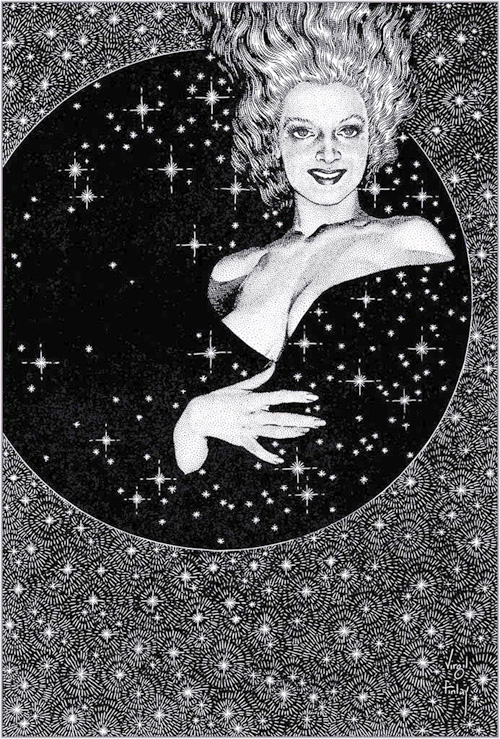
Artistic Inspiration: Virgil Finlay


Being one of the favorite artists of James M. of Grognardia means you're probably a good artistic inspiration for old school gamers. Add in the use of a relatively rare and interesting artistic technique and being one of the last of the old school illustrators and you probably have reached "significant".

Virgil Finlay is an odd choice for my series of inspirations. He is later than most artists I would feature and while he has some elements of movements that tend to speak to me (Pre-Raphaelite, Symbolism, and Art Nouveau) he generally does not fit. What draws me to him is his female forms (true of two of the three above, all but Symbolism) and some horrific elements (which touches on Symbolism). That said, his style is one of the archetypical one for the pulp era science fiction magazines.

First up is a picture titled Conquest of the Moon Pool which I am sure is related to the Merritt story, although Finlay was five when it was first published. Finlay did work for Merritt at The American Weekly.

Our second picture is more a direct inspiration to gaming. Get out your copy of Spelljammer and compare that image to the skeleton ship here. Which, to your mind, is more of a pulp fantasy magical flying ship. In fact, I'd love to see various people write up Finlay's ship as a treasure or even a monster.

Thursday, October 22, 2009

Recommending Products in Products

How do you view products that recommend other products inside them. Not full page ads but items like "a good system for generating unique demons can be found in Scribe of Orcus #2". Does it make it seem like you've been sold a broken or incomplete product? Does it matter if the products are produced by someone other than the producer of the book you're reading?

The reason I ask is I'm taking a first pass at some sections of A Demon Haunted world and I'm inclined to recommend items I use in developing the playtest scenarios (and if I get players the campaign).

A Demon Haunted World: The Problem of Gunpowder

In trying to have magical adventures in the modern day one must find a way to explain why heroes don't use guns. After all, if facing a demon would you rather have a sword or an AK-47? Some games handle this by making magical creatures have what amounts to tank armor for skin. An interesting, if not completely convincing idea outside of certain settings.

Of course, the easiest method is to claim magical creatures are invulnerable to modern weapons. To my mind, and many others, that is a cop out.

That said, if I want A Demon Haunted World to be modern sword and sorcery adventures I need a way to limit guns, flamethrowers, and artillery, among other things. To do this I'm going to look at modern weaponry a little differently. What if the wasn't from the bullet or the flame but from the source: a strange mixture that propels the sling stone instead of a sling or a strange mixture that burns instead of lamp oil?

Well, in the S&S world, especially in the context of Old School fantasy gaming we have a word for strange mixtures that can harm you: potions. We also have a way to escape harm from potions: saving throws. Why not allow creatures of myth and magic (including my Blooded race of humans) a saving throw against potions when attacked with modern (gunpowder and later) weapons, flame, and explosives. A successful save resists the potions effects and converts the damage into the equivalent muscle powered weapon: sling stones, natural fire, and so on. Or perhaps a save allows no damage. Tougher (more magical) creatures might get a plus on this save to reflect their distance from the modern world.

Wednesday, October 21, 2009

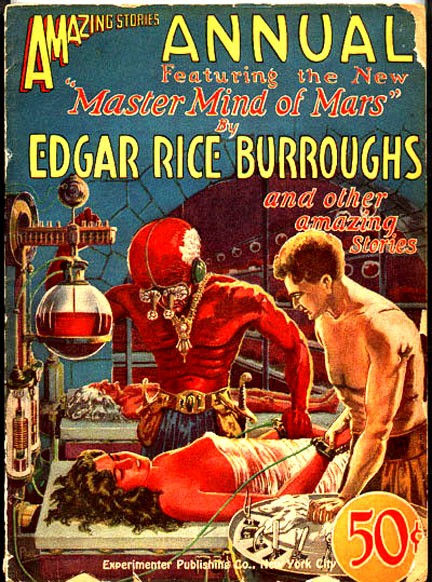
Artistic Inspiration: Frank R. Paul

Amazing Stories: Master Mind of Mars And we have another Barsoom illustration, this one from the Amazing Stories run of Master Mind of Mars by Frank R. Paul. Paul was Amazing's house illustrator from 1926 to 1929 and did a variety of other magazines as well. His most influential work was illustrating the Buck Rogers comic strip from its beginning in 1929. The visual vocabulary he started would be imitated in the Flash Gordon strip and serials as well as the Buck Rogers serial. He arguably defined what a spaceship would look like until the Enterprise's silhouette appeared with Star Trek (which was revolutionary in and of itself).

Wednesday, September 30, 2009

Artistic Inspiration: Wild Elf


I found this by a Google Image search for art nouveau elf. While this image isn't the one I found I think it's a great inspiration for D&D.

This image is titled "Sacred Weeds" and to me invokes the The Wild or a Mythic Wilderness.

Thursday, September 3, 2009

Mid-vacation humor post

From the Ansteorra mailing list:

>Obviously I've been gone *way* too long...that sounds like something you'd
>see in a D&D campaign...
>
>Alden (the old one)

Yes, but in D&D, the Savory Toasted Cheese has six hit dice, a cholesterol-based attack, and dissolves leather, wood and flesh. (Dire Savory Toasted Cheese has nine hit dice.)

Of course, "the old Alden" *also* sounds like something you'd see in a D&D campaign.


... or maybe a Toon campaign.


Anyone want to find art for using Savory Toasted Cheese in MF?